Review of ‘Music, Fashion, Film’, Charli xcx’s new album
A little over two years ago green flooded our lives. An intense green, perhaps even annoying. A green that, generating some confusion, at first meant nothing and, a few months later, ended up meaning absolutely everything. As if it were a chroma, the iconic green of ‘BRAT’ (24) was everywhere, it could mean anything. With that wonderful ode to club hedonism Charli xcx achieved the commercial peak of his career and, at the same time, the climax of a PC Music that seemed to have found its definitive form in that green chroma. To define hyperpop, Julie Ackermann talks about a hyper-fast, hyper-connected and hyper-sugar sound that generates “an ecstatic joy no matter what”but a chromatic nature also stands out in the subgenre. “As for the colors, they are never pale, but strident like the profiled body of a racing car”defends the French criticism. The green was not coincidental, but the conclusion of a musical philosophy that AG Cook and Danny L Harle created on a Tumblr blog more than a decade ago. The green was no coincidence and, of course, neither is the black and white of ‘Music, Fashion, Film”the new project of a Charli who believes that the dance floor is dead (“so now we’re making rooooooock music”).
“Rock Music” opens an album that, after much speculation, is confirmed as—indeed—a rock music album. Or, at least, like a guitar album. After in 2015 she told critics who called her out for using an inflatable guitar in her concerts to hell (“you can go f**k yourself”the singer said on the now defunct Twitter), Charli now dedicates eleven songs to squeezing out all the possibilities of the instrument, to experimenting with all its potential metamorphoses. Filtered, saturated, modulated, short-circuited and looped guitars (if in ‘BRAT’ pop was hyper-sweetened, here rock is hyper-processed). Grunge, pop rock, emo, shoegaze, post-punk and art rock. The string is so essential in Charli’s latest album that even her own voice chopped seems to be working like another guitar in the ecstatic chorus of “2007”the rock answer to his “1999” alongside Troye Sivan. If Oriol Rosell defends that hyperpop is really an exaggeration of pop codes, to the point where it is impossible to know if it is “experiments, tributes or parodies”, ‘Music, Fashion, Film’ proposes something very similar: a reappropriation of rock that wanders between the tribute to The Velvet Underground and the testing ground of an AG Cook obsessed with digitizing guitars – something that, by the way, he had already tried on some songs on his album ‘Apple’— (20).
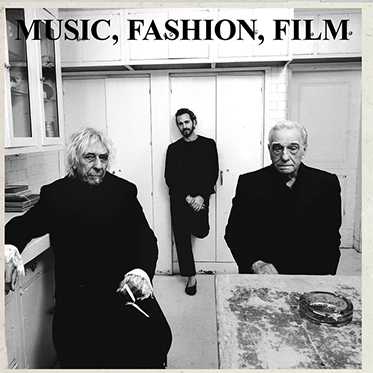
Green is replaced by black and white, hyperpop by (hyper)rock and the dance floor by the artist. In an interview on the online program “Subway Takes” of Kareem Rahma, Charli defended that what is truly important is not the music, but the “artist” (There is no literal definition in Spanish, but it would refer to art, talent or, ultimately, authorship). The title and cover of the British artist’s latest project are the most precise embodiment of this idea. John Cale (music), Marc Jacobs (fashion) and Martin Scorsese (film) looking at the camera, the three artistic disciplines brought together for only one reason: for Charli. The cover of the deluxe version of the album—in which the singer appears alongside the three protagonists—further underlines the meaning of a photograph that has been interpreted by many as slightly sexist. Why three men to represent music, fashion and cinema? Where are the women or queer identities? Perhaps the intention of the image is not only to make evident Charli’s cultural capital (capable of bringing together three eminences on her cover), but also to criticize how much we are taking for granted the all-terrain nature of an artist who, in recent years, has simultaneously been a protagonist in the fields that these three men represent. Maybe Charli wants to play at being an old glory, with the privileges that that label entails. The important thing is not the music, but the authorship. The important thing is not the songs, it is the artist.
Charli is music, but also fashion and cinema. In “SS26”the roar of the guitar accompanies lo-fi pop on a catwalk crossed by models and nihilism (““the world is gonna end, no hope for any of it”) in which Charli reflects on the dangerous balance between the superficiality of capitalist fashion and the existential debates that the exhibition entails, including explicit doubts about whether further exploiting her Indian origins would have been an interesting brand image. We can also find something of that dilemma between the person and the artist in “Camera” —perhaps the funkiest rock of the project—, a confession regarding Charli’s first authorial experiences in recent years. While the music pushes the singer toward self-consciousness and overanalysis, the performance seems to free a tired artist from the burden that comes with being herself (“I can be anything that I wanna be / And I can feel the things I don’t normally feel”). There’s something masochistic about a record she creates while watching herself the entire time. Susan Sontag would say that loving being in front of the camera is loving the adrenaline of being in the spotlight. “barrel of a gun (fucking shoot me!)”just as Charli sings in “Camera”. (There may be no better way to illustrate everything discussed in these last two paragraphs than the video clip of “Camera”: while Charli sings about the pleasure of being subordinate to another when standing in front of the camera, the images show us the singer on top of a film camera, directing the explosive masculinity of Vincent Cassel, shooting a bullet in his chest).
But perhaps one of the most pleasant surprises of ‘Music, Fashion, Film’ In other words, despite the undeniable—and expected—conceptual and existential burden of the project, listening to the half-hour album is surprisingly fun and adrenaline-inducing. It has merit to invoke so much dynamism, so much movement and so much carefreeness in a proposal that could have been limited to being a commercial suicide, a display of authorial power, a Warholian game. This is the antithesis of ‘BRAT’but that doesn’t make it boring (in fact, perhaps that’s why it seems so vibrant to us). Perhaps the best example of this is ‘Wink Wink’in my opinion the best song of Charli’s Lou Reed era. Literal lyrics, few shocks—in that sense, anti-hyperpop essence—and excited humor (“maybe I fucked you’re dad / just kidding, I’m only saying that for effect”) in a hymn to sexual freedom and continuous contradiction. The latter is in fact about “Yeah.”an explosion of guitar-synthesizers that you swear and swear and swear that you don’t want, but that you finally do want. We weren’t sure if we wanted this either, and we definitely did! Perhaps nothing goes better with an extremely hot summer than this guitar hedonism, that hyperbolic melancholy of “Magic Metal Montana”similar to that excessive nerdiness that arises late at night when you say “I love you so much, aunt.” to your party colleague (“love your haircut, love your dance moves / I’d cry if you die”).
There was a lot of criticism that came to Charli for saying that the dance floor was dead. But after listening ‘Music, Fashion, Film’I think his words take on another meaning. Making rock music (if that’s what Charli is doing here…) doesn’t so much mean creating without thinking about the dance, but creating without thinking about the dance floor. Pop culture is no longer governed by one sound or another (“How is Bad Bunny going to be king of pop, with reggaeton and dembow?”), but because of how many spaces it is able to occupy, because you can relocate the music from its usual places. While ‘BRAT’ was presented in boiler rooms, this new album has been presented in cinemas. If Charli is one of the most important pop stars of our time, it is precisely because she goes beyond the dance floor. Through what she understands as anti-marketing, Charli manages to move away from a hyperpop closely associated with digital capitalism to present an album totally unrelated to fashion that, most likely, will end up generating a trend. The important thing is not the album, but what the artistic decisions regarding it say about Charli. Let us remember that ‘Music, Fashion, Film’ is full of small commercial suicides, such as publishing a song alongside each single on a private Instagram account that has not been part of the album (except for “I keep on thinking about you every single day and night”the only one of these anti-system songs that appears as an epilogue to “Card Declined”, song that is, precisely, a parody of capitalist consumerism). The guitarist’s rebellious essence not only affects the sound of the album, but also Charli’s seemingly carefree attitude towards the reception of her work. Julie Ackermann reminds us that Jimi Hendrix did not sacrifice his Fender guitar in 1967 out of mere rebellious romanticism, but because his manager suggested the idea to him.
Of course, in no case could anyone dare to say that ‘Music, Fashion, Film’ is a marketing campaign orchestrated by Charli’s team. There is no doubt that Charli needed to break up with ‘BRAT’ with a voice that is as radical as possible, and without a doubt this album is the perfect response to that need to abandon that stage. Perhaps we could ask ourselves if behind this desire to make a project doomed to commercial failure there may be a certain desire to succeed with the losing horse, to win with the worst cards in the game; Yes, there may be some brand image in this destroyed Fender guitar. But that really matters little. What matters is that, at the end of the day, nothing is going to last forever. That’s the mantra Charli repeats in “No One Lasts Forever”the last song on the album that, accompanied by ultra-saturated guitars that advance in fits and starts, intones a final declaration of intentions. At the end of the song, David Cronenberg explains that, when one day he fainted on the street, when he suddenly found himself close to death, he did not think for a second about his art. The filmmaker praises those who have made their art embrace eternity, but states: “they are dead, they are gone / no one lasts forever.” The song—and the album—ends with that mantra repeating itself on a loop, almost silently. While ‘BRAT’ ended with an explosion of electronica, with a sequence shot of dance effusiveness (the same thing happened with ‘how i’m feeling now’), ‘Music, Fashion, Film’ It ends in silence, timidly short-circuiting, thinking about death, legacy and art. We’ll never know what Charli really wanted, but we certainly know what she’s achieved. (It’s nice to think that maybe Charli does think this album is going to last forever.)