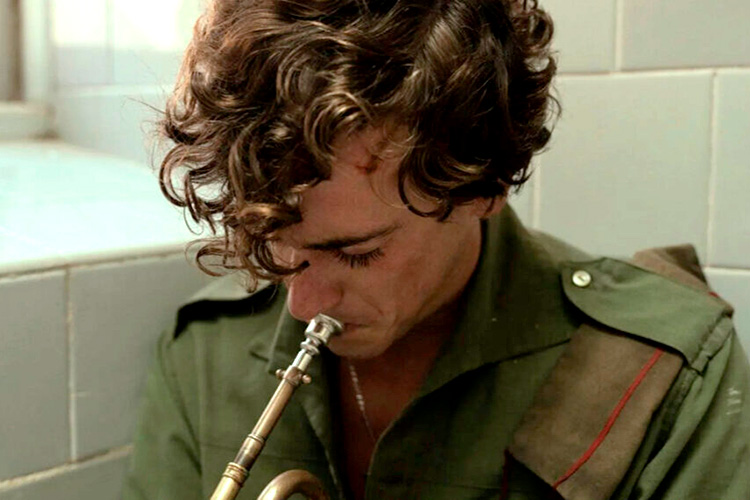
Review of ‘La Bola Negra’, a film that opens in theaters today, Friday
In addition to this house, I interviewed Javier Ambrossi and Javier Calvo for another website back in 2017, when I had just finished my degree in Medicine, but had not yet fully immersed myself in the audiovisual world. In an informal chat after the interview, while we were finishing the refreshments we had ordered, I told them where I was at, and they encouraged me to try my luck with that series that I was determined to turn into a reality despite being completely lost about it. Well, the truth is that if my self from then looked into 2026, I don’t know what would have blown his mind more: knowing that in 2026 anyone could watch the three seasons of my series on Filmin “An Andalusian Bitch”or knowing that the creators of that genius that I had seen in Flooxer were going to end up nominated for an Oscar
. If I’m honest, I suppose that mine would have seemed more impossible to me (although it is more achievable, one’s thing always seems more complicated), but here I am: if I start this review with this personal anecdote it is because, for all Spaniards, but especially for those of us who try to dedicate ourselves to this, what Ambrossi and Calvo have achieved is a milestone. Yes: whatever happens in the coming months, “The Black Ball” It is already a milestone of Spanish cinema. And it is even more so because they have not achieved international repercussion with a film that could just as well have been shot here as in Sweden, but with one that is one hundred percent Spanish, with our idiosyncrasy sprinkled in a thousand and one details throughout the entire footage, and all of its characters. As a result of this repercussion, two phenomena have been exacerbated among the people of this industry: on the one hand, a shameful dismissal of absolutely everything that Los Javis do, and, on the other, a fierce haterism based on envy, although they do not admit it. And look, it’s understandable, how are you going to dedicate yourself to audiovisuals in Spain and not envy Los Javis? We all do it, admiration and envy can coexist… but denying the envy present behind those criticisms is as absurd as saying that “The Black Ball”
It’s a bad movie. It is difficult to review “The Black Ball”
separating yourself from all the noise generated, making sure that you are not in either of these two aforementioned groups, and focusing on what you just saw on the screen. But what we see is, yes, the best Spanish film of the year, and a sign that starting from the local or even the personal is key to becoming universal. Of course, the ambition of “The Black Ball” It doesn’t always translate into success, but I will always prefer a story that exudes life to one that is seemingly perfect but cold. Ambrossi and Calvo take what is told in “The dark stone” by Alberto Conejero, and the little that is known about said work by Lorca (not unfinished, as Conejero pointed out on Twitter the other day, rather unpreserved), and they add a story in the present with which they weave everything, and how they weave it. This is an overwhelming film that wins in a movie theater, with the majestic photography of Gris Jordana, the vibrant editing of Alberto Gutiérrez and the intense soundtrack of Raül Refree contributing to that aspect. ‘bigger than life’
that surrounds the film. But where Los Javis shine again is in the script and in the acting section. No one is surprised that Lola Dueñas, Antonio de la Torre or Mona Martínez (the latter, despite not being so present in the media that address “The Black Ball”, is capital for the soul of the film). And we all know that Penélope Cruz has enough presence to go out for fifteen minutes and leave us amazed. And Carlos González, who has been the best of them for four series, should no longer be called a “promise.” But there were reservations regarding Miguel Bernardeu (more than “Want”, was “Elite”
what people still had in their heads) and, above all, many doubts about Milo Quifes and Guitarricadelafuente. I had them myself, why lie, and Ambrossi and Calvo had already shown their ability to bring out wonders in people without prior acting credits, but in whom they saw potential. Well, here it happens again: both the Huelva native and the Castellón native eat the camera, and manage to move the viewer. Yenesi works less, squeaking especially her appearance towards the end.
https://www.youtube.com/watch?v=9NNU-vSeOB0 We started by talking about the importance of “The Black Ball”
for Spanish cinema in terms of its international vision. But be careful with what it means for Spanish cinema itself, and for Spanish cinema’s commitment to queerness. There are few queer stories that we see in our cinema in such an organic way by their creators (outside of the tokens decided by the algorithm of the company in power). Therefore, although there are things that I miss (for example, I think the narrative would benefit from more desire), the fact that a twenty million blockbuster is LIKE THIS… is tremendous. For some of us it is impossible not to feel a little victory in everything that is happening to you, even though it apparently doesn’t make sense since we don’t belong on your team. But, as the film takes us along while weaving the different stories and encourages us to live without fear, perhaps we do have more in common than we think with other stories and other times. Maybe there is a certain sense of belonging and a certain community in all of this.
When I write these lines, “The Black Ball” is not nominated for an Oscar, hence the asterisk. But that’s how clear I have to be that it’s going to be.