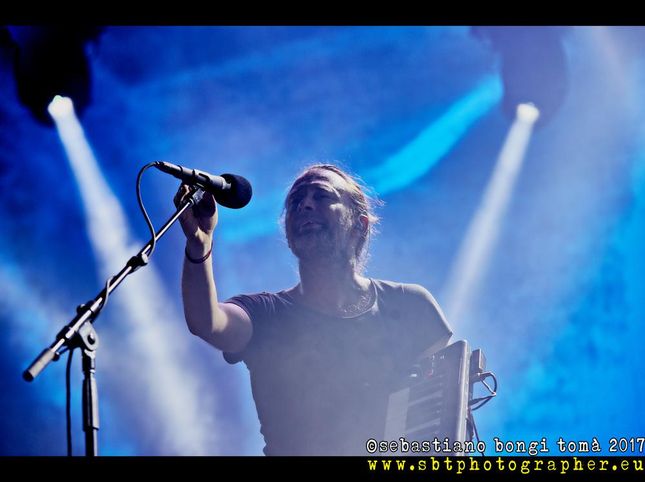
Radiohead, 25 years of “Kid A”, a record that rewritten the rules
On October 2, 2000 “Kid a” of Radiohead was released, an album that changed the perception of the mainstream and the way in which a successful rock band could choose to disappear and then reappear in a completely new form. Twenty -five years later, it is still an epochal album that makes its influence feel both in music and in popular culture and in the ways in which artists and bands conceive their identity.
The context: after “Ok Computer”, a leap into the void
In 2000, Radiohead were the reference rock band. After the acclaimed “Ok Computer”, published in 1997, they had become the obliged point of comparison for any alternative group – even the Muses were labeled as “the new Radioheads” to their beginnings. But instead of taking advantage of that success with a more accessible disc, Thom Yorke and members decided to spark the cards. “Kid A” came after three years of silence and waiting, in a pre-social time in which the news filtered through rumors, denials and advances in specialized magazines and on fans sites. The album presented itself as an alien object: no singles, no video clips, no promotional interviews. No “Karma Police”, no “No Surprises”, not even a “Paranoid Android”, the non-corzone that had anticipated “OK Computer”. Just a new, disorienting and fascinating sound, almost a lunge in the crisis of rock identity. “YesTerday i Wake Up Soaking in Lemon”, Thom Yorke repeated obsessively in the first song, “Everything in Its Right Place”. No, it’s not all right and Yorke and Radiohead seem more immersed in a Kafkian metamorphosis than a successful rock band, “Kid a” was also born from there: from the disintegration as an act necessary to be able to start building.
Another place, where everything is in its place
“Kid A” is, still today, a listening that challenges the listener. It is a disc that does not discount: it pretended attention, but repays with a gash on creativity. Each song overturns expectations. “Everything in Its Right Place” opens the disc with a fragmented and synthetic structure, where Yorke’s voice dissolves in the electronic loops. “Idioteque”, with its anxious pulsation is pointed to between dance and paranoia and plays with independent electronic music, to which Yorke would have often returned, in the following years. “How to disappear Completely”, with its arches, is one of the most touching ballads ever written by the band, while “Morning Bell” alternates sweetness and restlessness in a hypnotic spiral. And then there is “Motion Picture Soundtrack”, which closes the disc only apparently reassuringly.
There are no traditional structures, nor openings. Everything seems implicated: it is precisely in this tension, in that sound ambiguity, that the strength of “Kid a” is revealed.
Criticism and the public: shock, refusal, adoration
At the time of the release, “Kid a” divided both the criticism and the public. Some considered him a betrayal of rock identity, others greeted him as a visionary masterpiece. Incredibly the album debuted in first place both in the United Kingdom and in the United States, where over 200,000 copies sold in the first week. An unthinkable result for such a unconventional album, without individuals or classic promotion. “Kid a” became an instant cult, and opened the road to a wave of alternative music that felt free to abandon the song form. This is our review of the time:
The “amnesia” effect and the return of the double
A few months later, in 2001, “Amnesia” arrived. The surprise effect had vanished, but the interest remained very high. The disc collected songs engraved in the same “Kid A” sessions, and for a period the band had also thought of publishing them together as a double album. The choice to separate the outputs was wise, because “amnesiac” deserves an autonomous identity. Its opening, “Packt like Sardines in a Crushed Tin Box”, continued the electronic path of “Idioteque”, while “Pyramid Song” showed the most introspective and melodic side of the band. “Knives Out” reported guitars in the foreground, but with a text that closed every glimmer: “I Want You To Know / He’s Not Coming Back”. If “Kid A” was the breaking point, “Amnesia” was the consolidation of a new language.
The reissue of the twenty years and the virtual performance
In 2021, for the age of twenty, the Radioheads published the “Kid a Mnesia” collection, which unites “Kid a” and “Amnesiec” as if they were a single work – as initially imagined. The title is a small blow of genius, which returns to listening to a wider consistency. In addition to the two albums, the collection includes a third album, “Kid Amnesiaee”, with alternative versions, instrumental interludes, archival materials and above all the long -awaited publication in the studio of “Follow Me Around”, known to the fans and played sometimes live. A remarkable song, based on voice and acoustic guitar, but classically Radiohead, perhaps too “normal” to be included in these albums .. parallel to “Kid a Mnesia Exhibition” was also launched, a virtual and immersive experience that transformed the visual and sound universe of the album into a sort of digital installation.
The inheritance: the music after “Kid a”
25 years later, “Kid A” is unanimously recognized as one of the most influential albums of the 21st century. He anticipated the crossover between rock and electronics, inspired by a generation of artists – from Bon Iver to James Blake, to Frank Ocean – and showed that the avant -garde could also speak to the general public. He redefined what it means to experience, in a context where the risk was still possible, even for an already established band. In an era dominated by individuals and algorithms, “Kid a” remains a record to listen to everything in one breath, like a unique, coherent, complex, perfectly structured work.
Twenty -five years later, Radiohead return on tour, and everything is still in place. Except that it is, again, another.