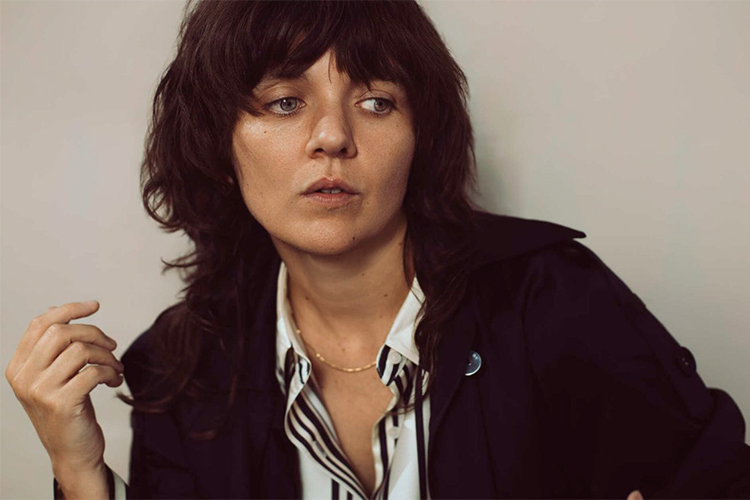
“I’m very proud of this album. It’s my favorite of all the ones I’ve made.”
I would say that “Creature of Habit” (Mom + Pop/Virgin, 26), released a few months ago, is the most consistent and addictive album of Courtney Barnett since his debut, that unforgettable “Sometimes I Sit and Think, and Sometimes I Just Sit” (15), which made her known as an outstanding figure in foreign alternative rock. She recorded it in Los Angeles, a city to which the Australian moved five years ago, with production by John Congleton, Stella Mozgawa and Marta Salogni. It is an energetic, resounding work, born from a time of changes: geographical and emotional. He takes care of me from his Californian home.
What is life like in Los Angeles compared to Melbourne?
Very different. I spent a year living in the Joshua Tree desert, which is very different from this. Los Angeles is different, but at the same time it has similarities with Melbourne. It’s always good to change cities and explore new places. I like hiking through these mountains, there are really beautiful landscapes.
Did it influence the album?
The place always marks the writing, in a way. Although I haven’t written about the experience of living in Los Angeles. Much of this material was written in the desert, or while traveling.
It is a more energetic album, did you need to mark a contrast with the previous one, “Things Take Time, Take Time” (21), which was more serene?
Yes, I wrote that one during confinement, without realizing that it was very calm, with few pretensions, and had that vibration… with slower tempos, and this one sounds bigger, higher, broader, stronger, and it doesn’t have that feeling that confinement instilled. It wasn’t intentional. Both albums reflect the time and place in which they were written.
A couple of years ago you told The Guardian that your goal with this album is for it to be the best of your career. Do you think you have achieved it?
I love it. I am very proud of this album. It’s my favorite of all the ones I’ve done. I guess that’s the goal, yeah. Do something to be proud of.
I started listening to it without knowing that John Congleton was producing it, and when I found out I understood it better: it has that sharp, crunchy and at the same time organic sound (not acoustic or analog) that so well defines the latest works of Sleater-Kinney, Death Cab For Cutie, Shame or St. Vincent. Was that what attracted you to him?
I love the way their albums sound. And it’s very fun to work with him. Stella Mozgawa and Marta Salogni began producing the first material, which was recorded in the desert. When we finished those sessions, we went to Los Angeles and continued recording with Stella and John, so each song has a slightly different combination of producers, and then John mixed the whole record. I finished it with him in Los Angeles, and I did some with him from the beginning, so the album is a bit patchwork, like a puzzle. Everyone contributed their share of magic.
What does the mantis on the cover represent? Is it some kind of metaphor?
While writing the song “Mantis” I was in the desert and still couldn’t come up with a chorus. One morning, while I was making coffee in the kitchen, feeling very sad and lost, I noticed a praying mantis that was on the door frame: I read that it is a symbol of good luck, that you are on the right path, and it was like the timing fit what I was looking for. It was like a sign from the universe, giving me relief and comfort. It stayed with me, as an important and beautiful moment. It became a chorus and a song, and a lyric that embraces the album’s title. In a song that is crucial for the album. When doing the artworkI remembered how important it was and found a photograph of Lilo Hess, which I fell in love with. Most of the photos of mantises you see on the Internet paint them as threatening insects, but this one is very sweet, cute, curious. It is an impressive photograph.
Do you feel music is a therapeutic activity?
It helps me. It’s fun too. The writing process helps me connect with my thoughts, clarify them and delve into the subconscious part of my brain, where all my insecurities come from: sometimes it is hard, but it is a very important process, full of meaning. It helps me understand what is happening.
By the way, one of the collaborations is Flea (Red Hot Chili Peppers), playing bass on a song.
Yes, in “One Thing At A Time”. We met a couple of times before participating in the Patti Smith tribute at Carnegie Hall in New York in March of last year. He was in the band. A couple of weeks later, recording that song, I needed a bassist and I called him. It’s perfect. An incredible bassist. And an extraordinary guy.
“I have never considered myself a singer. I was first a guitarist, then a song writer, and I was too shy to sing”
It has always seemed to me that one of the keys to your success is your very conversational way of singing, as if you were telling your confidential moves to a friend.
I don’t know how to sing any other way (laughs). I have never considered myself a singer. I was first a guitarist, then a song writer, and I was too shy to sing. It was more of an occurrence.
You were shy, you say: did you think you would become an artist of relative international success?
No joke. Not even dreaming of it. My last ten or fifteen years have been incredible: I never imagined this would happen. I feel lucky and grateful. Especially when I think about the time I spent locked in my room with a guitar, passing the time.
Do you think you are basically the same as you were in 2015?
In a way, yes, although I have changed for the better, in many things. Wait. Although the essence is there. There is a part of me, that comes from my childhood, that is still obsessed with music.
What current music do you like?
Good question. I listen to podcasts more than music. I really like a guy from Melbourne, Way Dinamic.