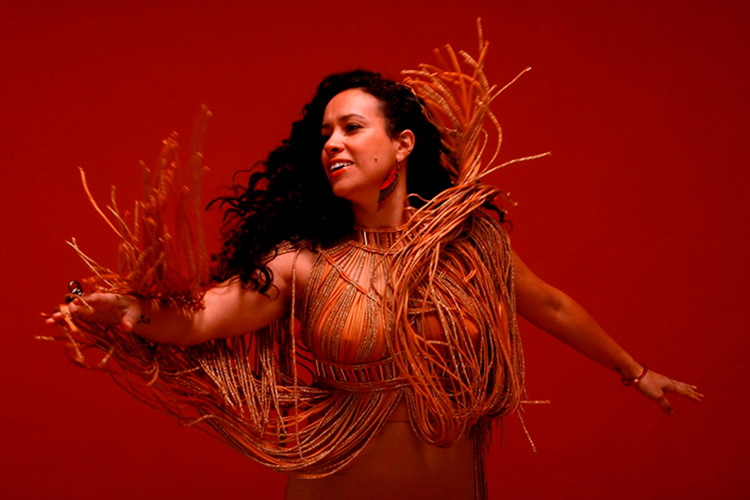
“I thought that in this life I would not be able to achieve my dream”
It’s been two years since The Yegros publish “Beam” (X-Ray/Canta La Selva, 24), but the Argentinian already has an album ready that will be released next year.
(You can check their dates within the Iberoexperia Sessions at the end of this interview).
The story of The Yegros It could be counted as that of an artist who brought chamamé and other rhythms from the Argentine coast to European festivals. Or like that of one of the fundamental voices of Latin American folktronica of the last decade. But perhaps the true story is another: that of a girl from Morón who dreamed of appearing on television, spent fifteen years looking for her place in music, ended up distancing herself from it and, when she had already assumed that she would never fulfill that dream, she found her way back to the stage after her thirties.
Currently, while juggling between motherhood and music, the Argentine singer continues to cling to an idea that runs through her entire career: there are many lives within one. ““They were the two great plans of my life: to be a singer and to be a mother,” explains. “Now I am in a very nice moment, saying goodbye to our last album and, at the same time, enjoying my motherhood. Finding balance, learning to continue being a woman, mother and artist.” A bobbin lace that, for now, gives him a break on the road. “Luckily, since she was born, my daughter sleeps every night. If she didn’t, it would be impossible to continue doing concerts. Three months later I started the tour and she always comes with me.”
“You have to learn to dance with sadness. That’s what chamamé taught me”
That instinct has also fully crept into an upcoming album that promises to break his own schemes.. “The new album is going to mark a before and after in my career. It’s completely different. We’re going to leave it on hold. But it’s thought of differently, you see; I started doing it during pregnancy. It’s made from another place,” anticipates.
For this new cycle, Mariana (Alejandra Yegros) has not needed to dynamite its foundations. At the center of the studio is Gaby Kerpel, producer, friend and squire for almost three decades. Their alliance is a small act of resistance: they survived more than a decade of marriage and also a separation that, far from wearing down the project, ended up strengthening it. “We are family; he is even my daughter’s godfather. It was he who invented my stage name and who gave me the first opportunity. Now we present a new electric trio format. When we go with the other band there are like ten of us, but now we travel again by van, by train… It’s like reliving the past. I love it because it reminds me of where I come from.”
And it all started in Morón, on the outskirts of Buenos Aires. A zip code in which to dedicate himself to music did not seem like the most likely destination. “My father was an electrician and my mother a teacher. The reality is that there were not many options to enter this world. I think I saw the first recital of my life when I was almost twenty years old.” Before that, music only existed on the other side of the screen. “I saw them on TV and that’s why my dream was to be there. In Argentina there was a program where kids who finished school went to see if they won a trip. My goal was not the trip: it was to see how TV was made, to meet artists. And we achieved it; we went like four times to participate.”
At the age of eighteen she left home and began a journey that led her to study at the conservatory and find a life between Barcelona, Los Angeles and New York. Years of trying, of constant movement, but still without finding a place of their own. “My first album came out when I was thirty-seven years old. I had been in the music world for about fifteen years looking for paths and I felt like I couldn’t find mine.” That’s when he made a radical decision. “I decided to leave music. I returned to Argentina and started studying fashion design. For me it was a struggle. I thought: ‘Well, in this life I’m not going to be able to achieve my dream.'” But the script decided to write another outcome. One day he met Kevin Johansen, who introduced him to Too Much Dick’s music. Some time later, chance wanted the two to cross paths. She confessed that years ago she had been a singer and the Dutch artist invited her to participate in a festival in Argentina. “I went up to sing and it was a sensation. That’s when the spark returned.” From that moment on, the project began to take shape alongside an emerging scene promoted by collectives like ZZK and artists like Chancha Vía Circuito, Axel Krygier or El Remolón: an electronic music crossed by folklore that opened a space that years before did not even exist in Buenos Aires.
The debut finally arrived in 2012, four years after songs like “Trocitos de wood” or “Cariño” had become regular pieces in the repertoire of King Koya, Gaby Kerpel’s band. And then it happened again. This time from the most unexpected place: France. “I don’t really know why, but in January 2013 my debut album started playing a lot there thanks to a station called Radio Nova. So many concerts started coming out that my manager recommended I stay and live. And it’s been almost fifteen years since this.”. The most curious thing about that connection is that it survived even the language barrier. “People don’t understand what I sing nor do I have French roots, but I think part of the success was the costumes and everything I learned studying fashion design: transmitting not only with music, but also with clothes and colors.”
Since then, her career has grown under a label that still accompanies her: “the queen of the new cumbia”. She downplays it. “In my entire career I have only done one cumbia, ‘Viene de mi’, which was a success. There are many more chamamés or carnavalitos.” Because, in reality, his roots are in Misiones, the province from which his parents come. “As a child I drank a lot of chamamé, I grew up with it. The songs are usually melancholic, but with a lot of rhythm. ‘Trocitos de wood’ is a very sad song, but people dance and jump. You have to learn to dance with sadness. That’s what chamamé taught me”. Today, with four albums behind her, a fifth on the horizon and a daughter accompanying her on the road, Mariana continues to do exactly that. Learn to dance. And, by the way, make the rest of us dance.