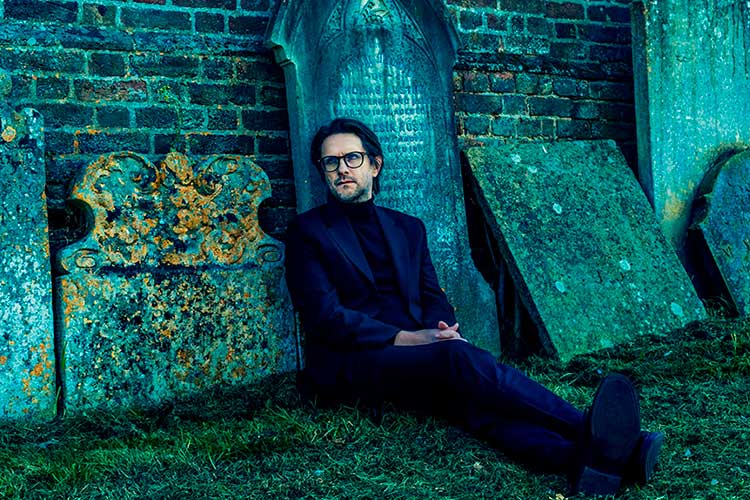
“I have the impression that we have lost something very magical from the pre-technological era”
“Requiem for a Village” (Fiction Records, 26) comes as the Briton’s most personal album Steve Wilson. A new example of a talent impossible to locate by an artist capable of creating a universe outside of time and space.
Steve Wilson offers us another hypnotic journey between progressive rock, alternative pop, cinematic post-rock, psychedelic folk and analog electronics. The setting is an enigmatic nameless town. Inspired by the folk horror that the musician loves (his favorite film is “The Exorcist”) and accompanied by a guitarist and drummer Russell Holzman – although the texts are co-written again by Andy Partridge (XTC) and the actor David Tennant acts as narrator – his proposal works as a mysterious elegy for a world that is disappearing before our eyes, annihilated by a ubiquitous and disruptive technology.
At the UMusic hotel in the center of Madrid, the Porcupine Tree frontman once again shows himself as a passionate and restless guy, with a youthful enthusiasm. His small blue eyes shine with that unmistakable sparkle. “It’s a very nostalgic album for me, because I long for the time before the Internet, social networks and artificial intelligence. A time when information traveled more slowly. I didn’t grow up in a small town, but in a city of eighty thousand inhabitants, but it was my world.” The British have the impression that “We have lost something very magical from the pre-technological era. The relationship with the countryside, with our environment. Technology has become a central part of our existence. It has been fascinating on the one hand and horrendous on the other how the human species has evolved since the invention of this (points to my smartphone, which acts as a recorder).”
“This album has an almost anti-AI approach”
“Requiem for a Village” It is, in large part, a reaction. “One of the central themes is trying to return to a more organic way of making music and accepting imperfections. Modern music sounds so perfect to me in the technical sense that it bores me a lot.”
Wilson went so far as to tinker with analog synthesizers that he collected and drums – which he didn’t master – and asking his regular guitarist Randy McStine (Lo-Fi Resistance) not to tune the guitar when recording. “Many would have told me to go to hell and would have resigned if I asked them to play the guitar as they played it. But Randy, who is an amazing guitarist, understands that non-musical aesthetic I’m talking about: that sometimes there is something magical in imperfection.”
If you put the microscope on a classic David Bowie album, for example, you will be amazed to hear how it was not in tune at all. Wilson has remixed quite a few classic albums – from King Crimson to Jethro Tull – and has seen it in detail. “I like those albums a lot partly because of the flaws, the imperfection. That has been completely lost, and not only in pop. In modern metal it happens a lot. In hip-hop, in country… Everything seems generated by an AI algorithm. I wanted to get as far away from that as I could.”. Although he continues: “A lot of current music sounds banal to me because I neither see nor hear the traces of its authors. Listen to Bowie, Morrissey in The Smiths… The voice is very out of tune. Bowie, Robert Smith… even Frank Sinatra didn’t nail the notes. Now they would put a fucking Auto-Tune on it.”
The problem is that “A lot of young listeners have grown up with shows like American Idol and all those singers do what I call ‘fake emotion’. It’s horrible. I guess young people’s brains have been molded to respond positively to it. I hate it with all my soul.” The musician also applied this radicalism to his voice, admitting that it was the most difficult. “The challenge this time was not allowing myself to fix things. Because I like records that sound sumptuous and produced. And it was difficult for me, because I’m not a great singer. I have something different, but I’m not the best, and many voices are very forward and naked. I had to stop myself, because fixing things is the easiest thing in the world today.”
Wilson, who intuitively combines melodic and rhythmic complexity, darkness and pop immediacy, plays with genres as diverse as psychedelic folk – with a great tradition in his country –, post-rock and even metal. “When I go into the studio to make music I don’t start analyzing. I let things come out”he assures. His drums in this unique work come from the world of drum’n’bass. “I chose him because he has a completely different sensibility. He works in the world of electronic music. That gives a very different flavor to the music.”
The Brit has no plans to play “Requiem for a Village” live, beyond the three songs that will be included in two big shows planned in London, accompanied by an orchestra of fifty people. Although the orchestra will not accompany him in these songs. “I’m starting to think about taking the album to the stage, it could be exciting and different. People are liking it, and I didn’t expect that enthusiasm.”
In personal terms, it is “delighted” with a career that has allowed him to do “exactly what I want”although he admits that his chameleon vision does not make things easier for him. “Not writing ‘songs’, but pieces of cinema for your ears, is harder to sell in a world where everything is instantaneous. But I see that the pendulum is beginning to move in the opposite direction. More and more young people are looking for something deeper and with soul, and that is hopeful. I have to be optimistic”.