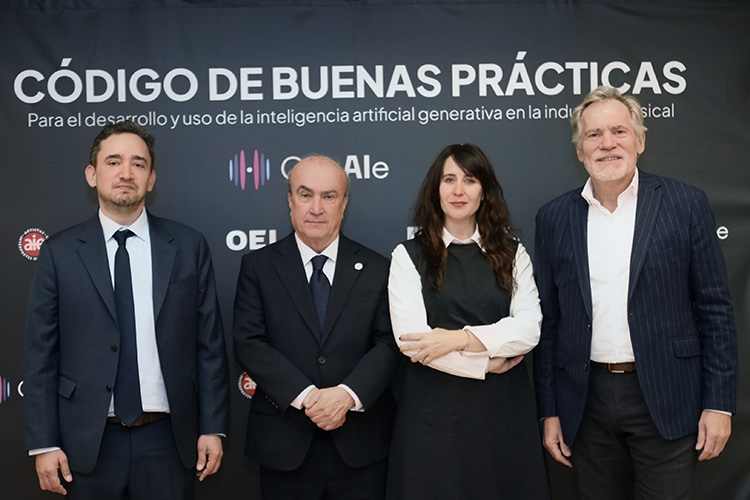
GenAIe (AIE) promotes the first Code of Good Practices to regulate the use of AI
The first Code of Good Practices is born to regulate the use of artificial intelligence in music
Driven by GenAIe (AIE) and already supported by 35 entities, the initiative requires express authorization to clone voices, transparency in the training of models and fair remuneration for creators.
The music sector has taken a step forward to establish rules of the game in the face of the rapid advance of generative artificial intelligence. GenAIe, the Analysis Unit on AI and Music promoted by the Society of Performing Artists (IEA)presented this Wednesday in Madrid the first Code of Good Practices aimed at making technological innovation compatible with the sustainability of the industry and the protection of creators’ rights.
The document, which functions as a framework for self-regulation and voluntary adherence, was created with the initial support of 35 companies, institutions and organizations in the musical and technological field, and remains open to new incorporations. The presentation event took place at the headquarters of the Organization of Ibero-American States (OEI), with the objective of projecting this consensus towards the entire Ibero-American space.
During the opening, the executive vice president and CEO of AIE, José Luis Sevillanostressed the need for musicians not to be left behind in this transition: «Artificial intelligence opens new possibilities for musical creation and production, but it is essential that artists are protagonists of this transformation and that the value of their creativity is preserved». For his part, the secretary general of the OEI, Mariano Jabonerohighlighted the importance of international cooperation so that the development of this technology “encourages creativity and cultural diversity.”
Eight pillars against deepfakes and opacity
The Code is aimed at the entire value chain—from musicians, record labels and publishers to AI developers and digital platforms—and articulates its commitments around eight fundamental principles:
Voice and identity protection: Vocal cloning or recreation of identifiable features of an artist will require prior, express and informed authorization, shielding performers from impersonations and deepfakes.
Transparency and labeling: Technology companies are urged to report the catalogs used to train their algorithms, as well as to preserve metadata and label works generated or assisted by AI to avoid misleading the public.
Remuneration and contractual balance: The text supports licensing models that guarantee fair economic compensation for the use of works or interpretations, requiring specific contracts that avoid generic or abusive clauses.
Training and global reach: It promotes awareness about the risks and opportunities of AI, in addition to promoting common legal standards at an international level to avoid legal loopholes.
An Ibero-American look at the technological challenge
The day included a discussion table moderated by the general director of AIE, Álvaro Hernández-Pinzónin which representatives of musicians participated (Guillem Arnedo, president of the Unión de Músicos), the recording industry (Verónica Casas, CEO of Blanco y Negro Music), the academic field (Raquel Evangelio, from the University of Alicante) and the technology sector (Axel Brando, president of TRAILAB). They all agreed to point out trust and traceability as essential requirements for coexistence between both sectors.
The international dimension was represented by Rodrigo Osoriopresident of the Chilean Society of Musical Authors and Performers (SCD), and María Isabel Arosemena, national director of copyright of SENADI of Ecuador, who valued the document as a key roadmap for the region. The General Director of Culture of the OEI, Raphael Callou, closed the meeting by calling for technological governance “at the service of people” that guarantees an equitable distribution of the benefits of innovation.