Christmas Notes: “In dulci jubilo”
From the book “Note di Natale” by Davide Pezzi (with a preface by Arturo Stàlteri) published by VoloLibero we publish some of the 95 songs covered by the author in the 300 pages of the volume; we tried to choose the least “predictable”.
It’s a winter night in 1328, it’s almost time for Christmas, but for the Dominican friar Heinrich Suso it’s another night of mortifications, of self-inflicted suffering to get closer to the suffering of Christ. This night the monk has a vision, in which he joins the angels who dance and sing. «Now, this same angel brightly approached the Servant (Suso), and said that God had sent him to him to bring him heavenly joys in the midst of his sufferings; he added that he had to eliminate all pain
from his mind and join them, and that he also had to dance with them in a celestial way. Then they dragged the Servant by the hand into the dance and the young people began a joyful song about Baby Jesus, which goes like this: “In dulci jubilo”, etc.».
These words belong to the biography (or perhaps autobiography) of Heinrich Suso (or Seuse), a German mystic and Dominican monk, venerated as a saint during his lifetime and beatified in 1831 by Pope Gregory XVI. Widely read in the late Middle Ages, he left several writings – although not all of certain attribution – including the text in macaronic – that is, a mixture of Latin
and German – of the anthem “In dulci jubilo”. The melody of this song appears for the first time around 1400 in a
manuscript in the Leipzig University Library, although it is believed that some versions could date back even before 1328, the date in which – according to his own, perhaps somewhat hagiographic, account – the song was dictated to Suso by angels. The first printed publication of “In dulci jubilo” dates back to 1533, when it was included in the Lutheran hymn collection “Geistliche lieder” by Joseph Klug; also appears in Michael Vehe’s “Gesangbuch”, published in Leipzig in 1537,
and in 1545 in Valentin Babst’s “Geistliche Lieder”, with an added verse probably written by Martin Luther. However, the melody was also popular elsewhere in Europe and appears in a Swedish/Latin version in the collection of medieval sacred and profane songs “Piae Cantiones”, published in Finland in 1582.
Over the centuries the melody of “In dulci jubilo” will have a great influence on the music of many important classical composers: it appears in several collections by Michael Praetorius, Johann Sebastian Bach will make an arrangement of the melody in his Chorale Preludes for organ, and Dieterich Buxtehude will do the same, while Franz Liszt will include the song in his piano suite “Weihnachtsbaum”, and Gustav Holst in his choral fantasy “Christmas” Day” of 1910.
The first English translation perhaps appeared as early as 1540, but for a version that maintained the macaronic structure – with the replacement of German with English – it was necessary to wait until 1837, when the English composer Robert Lucas de Pearsall created a polyphonic arrangement for eight voices, subsequently adapted for four voices by William Joseph
Westbrook, which will become the most commonly performed version. Other versions in English will be proposed over time, but they are rather criticized because they do not respect the original German/Latin alternation. Pearsall’s love and respect for this song can be found in a note that accompanies the publication of his translation: «The words are
quite remarkable, being written half in Latin and half in the Upper German dialect. I translated them to fit the music and tried to preserve, as much as I could, the simplicity of the original. Of the melody one can only have one opinion; that is to say, that which, despite religious animosity, assured her for many centuries the approval of Catholics, Protestant reformers and that of the German people.”
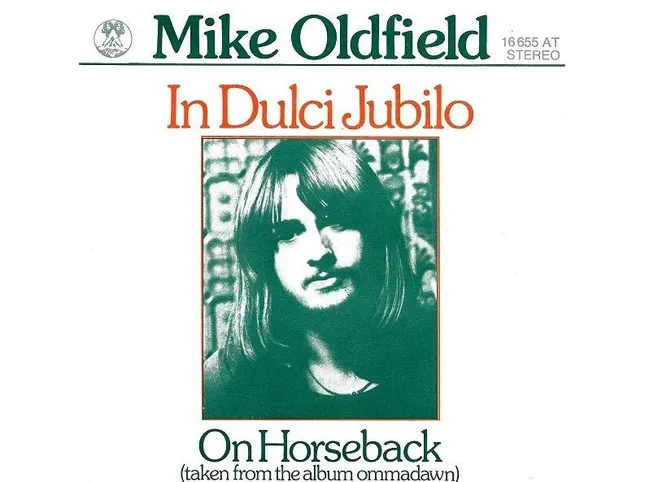
In 1976 Mike Oldfield reached number four in the English singles charts with a very lively instrumental arrangement with a medieval flavor of “In dulci jubilo”, in which obviously, as usual, he played all the instruments.