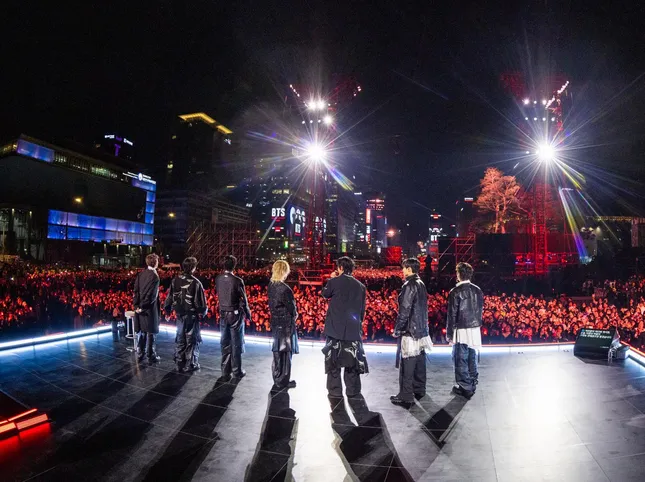
BTS: 260,000 people in Seoul for the comeback live
“BTS The Comeback Live | Arirang” took place in Seoul (here is an in-depth analysis), an event broadcast live from Gwanghwamun Square to accompany the release of the new album “Arirang”. BTS returned to the stage with a performance built on twelve songs, including new productions and titles already consolidated in their repertoire. According to the BBC, around 260,000 people were present in the square. The setlist included “Body To Body,” “Hooligan,” “2.0,” “Butter,” “Mic Drop,” “Aliens,” “Fya,” “Swim,” “Like Animals,” “Normal,” “Dynamite,” and “Mikrokosmos.” Eight tracks of the new project were performed live for the first time. The show was also broadcast on Netflix.
The opening was entrusted to “Body To Body”, introduced by an arrangement that recalls “Arirang”, a traditional Korean song. The opening scene involved fifty dancers arranged on a platform above the Gyeongbokgung Palace complexwith a choreography that accompanied the group’s entrance. During the show, “Aliens” developed a visual system based on the geongongamri trigrams, also present in the South Korean flag, used as a graphic element on the screens. The symbolic references continued in “Normal”, “Like Animals”, “Swim” and “Fya”, where taegeuk-inspired patterns built a visual line consistent with the album’s theme.
The already known songs, including “Butter”, “Dynamite” and “Mic Drop”were inserted in alternation with the new tracks, maintaining a structure that balanced recognizability and updating of the repertoire. “Swim” proposed a more essential staging, centered on vocal performance and reduced choreographic movements. In closing, “Dynamite” and “Mikrokosmos” accompanied the finale, with a system of progressively illuminated LED cubes and extended projections on the walls of Gwanghwamun Square. The show developed between the square and the palace area, combining a historical context with a contemporary productionand inserting elements of Korean tradition within a structure designed for an international audience.