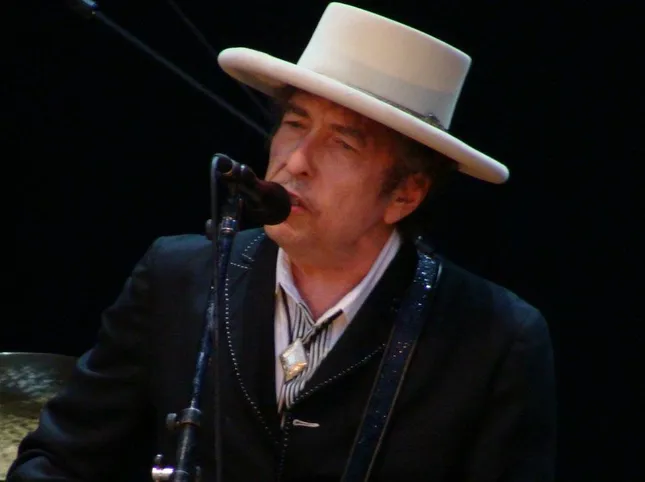
Bob Dylan shouldn’t be taken too seriously
Bob Dylan crosses the finish line today 85 years old. An anniversary that will inevitably (but understandably) attract the usual slew of solemn celebrations, academic essays on its literary value and praise to the “prophet of a generation” or the severe guardian of the Great American Songbook. Yet, fifty years of Dylan exegesis should teach us that “the minstrel” does not like hagiographies, because they often run the risk of missing the target due to a fundamental misunderstanding: take it too seriously.
Reducing Dylan to a rigidly monumental figure means ignoring the lifeblood that flows through all of his work: Dylan is not (just) a prophet lent to folk; it’s a trickstera master of the absurd and the grotesque. Since his beginnings in the clubs of Greenwich Village, humor and irony they were more than elements of color, they were rhetorical strategies, defensive shields and distorting lenses to tell reality. And they should not be overlooked.
Humor in DNA
To understand the comic component in Dylan, we must go back to his musical DNA. Before discovering French symbolism or the Beat Generation, the young Robert Zimmerman feeds on American folk and blues traditionin which wit and exaggeration (tall talesexaggerated folk tales typical of American frontier folklore) are structural elements.
The main vehicle of this first phase is the Talking Bluesa semi-spoken ballad form made famous by Woody Guthrie. In songs like Talkin’ John Birch Paranoid Blues (1962) or Motorpsycho Nitemare (1964), Dylan uses the political satire and everyday surrealism to dismantle the anti-communist paranoia of McCarthyite America and provincial bigotry. The approach is exquisitely slapstick (the comic genre based on physical and visual exaggeration, that of Charlie Chaplin, Laurel and Hardy or Buster Keaton, for example): the protagonist is a confused anti-hero, who looks for communists under the bed or ends up fleeing from a farm chased by an armed father-in-law like in a silent film comedy. Which is also a way to democratize the protest: where the traditional political song risks moralistic didacticism, Dylan chooses the path of derision.
Well, I got up in the mornin’ I looked under my bed
I was lookin’ every places for them goal-darned Reds
Looked behind the sink, and under the floor
Looked in the glove compartment of my car
Couldn’t find anythingLook behind the cloths, behind the chair
Lookin’ for them Reds everywhere
I looked way up my chimney hole
Even looked deep inside my toilet bowl
They got away
The electric period and caustic irony
Between 1965 and 1966, with the trilogy Bringing It All Back Home, Highway 61 Revisited And Blonde on BlondeDylan’s humor undergoes a chemical and literary mutation. Under the influence of psychedelics, reading Rimbaud and the tensions of celebrity, the comedy becomes caustic, cerebral and deeply ironic.
Irony turns into a weapon of self-defense against the press and fans who demand messianic responses from him. In fact, the press conferences of those years were avant-garde comic performances. In songs, this translates to a picaresque surrealism. In Bob Dylan’s 115th Dreamthe discovery of America is rewritten as a delirious journey in which Captain Arab (who recalls Ahab in Moby Dick) finds himself dealing with the police, illegal parking attendants and crazy restaurateurs.
In Leopard-Skin Pill-Box HatDylan mocks the bourgeois status symbol obsession by reducing a female figure to a ridiculous fashion accessory; the tone is not one of moral condemnation, but of amused and ruthless observation of the absurd. In Tombstone Blues the targets are institutional authority, war and academic culture: the text assembles historical, mythical and everyday figures in a vortex of nonsense – like Jack the Ripper who works at the Chamber of Commerce – to criticize US hypocrisy, the establishment and the anxiety of the modern erato mock social conventions and the corruption of power.
The taste for the grotesque
As Dylan’s humor progresses through his discography, he progressively veers towards the grotesque. If we define the grotesque (according to the canons of literary criticism, from Mikhail Bakhtin to Wolfgang Kayser) as the coexistence of frightening and ridiculous elements, the union of the sublime and the lowly corporeal, then Dylan’s universe is saturated with it. Monumental songs like Desolation Row (1965) or the whole Masked and Anonymous (2003) work like gigantic Bakhtinian carnivals. Historical, literary and biblical characters (Cinderella, Einstein disguised as Robin Hood, the Phantom of the Opera, Cain and Abel) are torn from their solemn context and placed in a circus of freaks.
This taste for the grotesque emerges forcefully in his late production. In Rough and Rowdy Ways (2020), and in particular in the song My Own Version of YouDylan takes on the role of a mad scientist à la Frankenstein who frequents morgues to “create his version” of a perfect human being, mixing quotes from Shakespeare, cigarette packs and the pacifist scientist intended as a character.
A perfect example of how Dylan’s comedy can transform itself into a complex narrative structure can be found in Highlandsthe 16-minute closing track of Time Out of Mind (1997). The album is universally described as a dark treatise on mortality, isolation and the end of love. Yet, in the midst of this desolate atmosphere, Dylan inserts a very long comic sequence set in a Boston restaurant. The interaction between the narrator and the waitress is a clever piece of humor based on miscommunication: the protagonist asks for hard-boiled eggs, but the waitress replies that they don’t make them. She accuses him of not reading contemporary authors and asks him to draw a portrait of her. He draws a woman with a chair attached to her head. Then the dialogue stalls in sharp and cold lines that recall Samuel Beckett’s theater of the absurd. This comic insertion does not weaken the tragic nature of the album, on the contrary: it enhances it through contrast. Humor becomes the only possible reaction in the face of old age and urban alienation.
Escape the golden prison
Summing up: Bob Dylan has been trying to escape the golden prison of High Culture for a lifetime. To understand it you have to accept it intrinsically contradictory nature of his genius. Anyone looking for him solely as a philosopher or political activist will remain perpetually frustrated by his confusions, by his records of Christmas songs (Christmas in the Heartplayed with a deliberately forced and ironic voice), from his advertisements for Victoria’s Secret or from his sardonic silences.
Irony and the grotesque are the keys to his artistic freedom. Stopping taking him too seriously is the greatest act of respect that can be paid to an artist who has spent his whole life escape the definitions of others. Dylan knows the apocalypse is near, but he also knows that as the world falls apart, there’s no reason not to have a laugh.