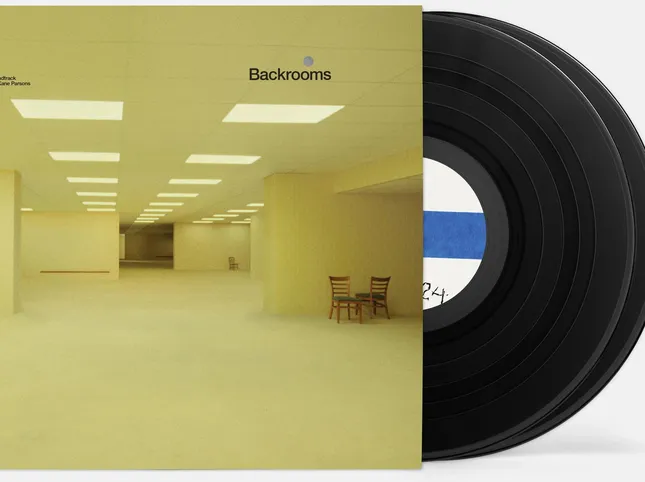
“Backrooms” also works thanks to the soundtrack
Backrooms – debut feature film by twenty-year-old Kane Parsons under the aegis of A24 and the team of James Wan (director of Saws and of The Conjuringto name two) – is the clear demonstration of how a very strong idea can pulverize the limits of a limited budget. Born as a creepypasta and exploded as a web phenomenon on YouTube (but also on TikTok), the film explores the “liminality“: dehumanized transition spaces where the subconscious collapses into a claustrophobic nightmare.
The visual aesthetic – kilometers of yellow carpet and labyrinths of identical offices – is now rooted in the imagination of those who have fallen into these disturbing loops, but to elevate the film from an internet phenomenon to a true psychological horror of Lynchian origin, Parsons had to rely on the invisible. It is the sound infrastructure, in fact, that makes the work a real sensorial trauma.
What does a prison sound like?
In a traditional horror or big-budget blockbuster, music often has a didactic purpose: it builds tension and anticipates the scare by exploding in the jumpscare. In Backroomsthe soundtrack does the exact opposite: it expands the wait infinitely, taking away every point of reference.
Co-composed by the director himself and the Canadian musician Edo Van Breementhe impressive score (published by A24 Music in a 27-track edition) almost completely dispenses with conventional melodic themes. Instead, it moves across territories dark ambientmenacing drones, and a sound design that constantly blurs the line between the physical room and the music.
Tracks like Handprint or the dilated one Complex they do not accompany the action: they themselves become part of the anguished architecture of the film. The idea is to translate the liminal space into sound: an environment designed for temporary transit that has become stuck, transforming into a eternal prison.
The legacy of David Lynch
The call to David Lynch does not stop at the dreamlike and surreal logic of the sequences, but delves deeply into the way in which Lynch and his historic sound engineer, Alan Splet, conceived horror since the days of Eraserhead. In Backroomsthe main threat is not just the entity prowling the corridors, but the environment itself. Van Breemen and Parsons make this threat tangible by working surgically on acoustic insulation and disturbing frequencies: what at the beginning of the film is a simple buzz of neon is imperceptibly sampled, layered and transformed into a suffocating rhythmic carpet.
The use of deliberately out-of-phase analog synths creates a sense of corrupt nostalgiaas if the collective memory of an 80s office was rotting in real time. In songs like Furniture Lamentbroken melodies and hints of “elevator music” emerge and end abruptly, mimicking the way the human brain desperately searches for patterns and logic where there is only alienation.
The Boards of Canada
To seal this cathedral of discomfort there is the use, in the closing credits, of a song taken from Hellthe new album from the Scottish duo Boards of Canada.
Undisputed pioneers ofhauntology (philosophical concept coined by Jacques Derrida in the book Specters of Marxa French portmanteau of haunted and ontology that describes the condition in which the present is haunted by ghosts of the past and lost futures), masters of using analog synthesizers and vocal samples to evoke memories of a past that never existed, the Boards of Canada can be considered the spiritual fathers of the sound aesthetics of backrooms. Their music closes the film by making explicit the subtext of the work: a generation lost in the labyrinths of its own artificially recreated past.
If Parsons’ film is having such a transversal success (it is the studio’s first film to exceed 200 million dollars, with a production cost of less than 10 million), the credit is largely due to this visceral sound ecosystem. Because when the screen goes black at the end of the screening, it’s that disturbing buzz that you take home.