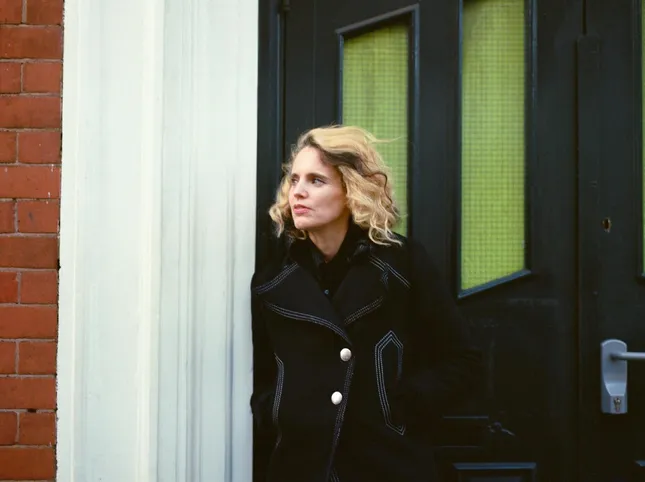
Anna Calvi, the peaky blinder of music: art comes first
Anna Calvi’s voice is incisive and enchanting when she dialogues with that of Iggy Pop in the single “God’s lonely man“, where the song of a destructive internal monologue takes shape, crossed by tension and the desire to reset. Solid but at the same time versatile, able to naturally modulate rhythm and intensity, the British singer-songwriter lets her vocals slide from soft to the most acute surges, passing through almost whispered nuances without ever showing signs of failure. In “I see a darkness“, a rereading of Bonnie Prince’s song Billy, Anna Calvi’s voice becomes deep and magnetic, while together with Perfume Genius she investigates solitude as a space of revelation and shared fragility. When she answers the phone, reached by Rockol to hear about two important projects which see the light in the month of March, the English musician’s voice instead arrives with sweetness, filtered by calm and tranquility. After collaborating on the project Help(2)” (here is our review and here’s more information), the new charity collection by War Child released March 6thAnna Calvi released her new collaborative EP on March 20th “Is this all there is?”.
Four songs, four collaborations, four characters: the singer-songwriter’s new project moves like a small narrative architecture, almost cinematic, in which each voice becomes the body and perspective of the same question, the one evoked by the title, which can be literally translated into Italian as “Is that all there is to it?“. Calvi tells Rockol clearly, letting the emotional core that holds the project together emerge:
“I would say the feeling is that of wanting something more. That’s what for me is “Is this all there is?”. It’s having the courage to hope that life can offer more or that it can be better than it is, that we can get out of this nightmare that we seem to be in. I wanted the record to have a cinematic dimension, with different characters carrying the narrative forward, almost embodying the song as if it were a film. And that’s why it was an incredible honor to have these extraordinary singers as characters alongside me, in this arc narrative”.
It is precisely this idea of construction by figures that makes the disc an organism in continuous movement, where differences become structure. In this narrative, the bravado and physicality of Iggy Pop coexist, who opens the work with a menacing groove suspended between pulsation and punk tension, to the fragile and restrained whisper of Perfume Genius, up to the lucid estrangement of the “Computer love” performed by Laurie Andersonwho seems to dismantle and recompose the meaning of the words as he pronounces them. The finale, entrusted to the duet with Matt Berninger on the title trackinstead returns to a more recognizable territory, but does so by crossing a broader, stratified, almost industrial emotional landscape, in which voices seek and chase each other.
Every collaboration is born from a precise imagefrom a voice imagined before it was even real. The curiosity is whether they are guided by an emotional affinity, by an artistic alignment or even by that possible creative friction that can generate new directions. Anna Calvi then explains:
“It depends on the song. “God’s lonely man” I wrote thinking about Iggy Pop, for his voice, without knowing if he would agree to collaborate. It’s a song that talks about frustration, the desire for something more and the desire to destroy everything to start again. I thought his voice was perfect for this anti-hero figure. I was very lucky that he listened to it, liked it and wanted to be part of it.
So, every song has a different story. For each song, I thought about who could embody that particular character. And then they are also my heroes. I’ve been incredibly lucky to have with me, on a record, the people who inspire me the most.
In this sense, “Is this all there is?” it is not a simple collaborative exercisebut a work built by subtraction and choice, in which each presence is functional to a precise idea of the story. Also the way of working reflects this tension between distance and connection: “Today, very often, you can’t work together physically, to work in the same room”, says the English musician: “For example, Iggy recorded his voice in Miami, while I was in the studio with Mike – aka Perfume Genius – in New York. It was really stimulating to watch him work, because Mike is an incredible singer. It was beautiful to see how he approached the song. I redid my vocal parts after his, to adapt to his energy”. He adds: “The process is different for every song, but the best moments are when you can be in the same room with a singer.”
What remains, beyond the individual traces, is an idea of music as a shared space but rigorous, where openness does not exclude a strong authorial identity. When asked which one it is the gift or the strongest aspect that the collaborations for “Is this all there is?” they left themCalvi summarizes his response with a clarity that also seems to reflect a new phase of his journey:
“The artists I feel drawn to all have one quality in common: they put art first. They put art first and want to take a path with their work, following what they need first, and then the audience. They are very focused on the art, and that’s really inspiring, because I think that’s what leads to the best music. And they’re very brave in what they do. Being around such dedicated people is truly inspiring.”
In his present, this urgency moves on multiple levels. In fact, alongside the EP, Calvi was recently involved in “Help (2)”, for which she recorded “Sunday light” together with Ellie Rowsell, Nilüfer Yanya and Dove Ellis. A piece that comes from afar, from a theatrical context, and which finds a new place here. The story is that of a fragile but resilient childhood, told through intimate images and essential writing. By reworking already existing material, Anna Calvi kept the heart of the piece intact, slightly shifting its meaning to adapt it to the project, which also took shape thanks to James Ford’s invitation. The atmosphere, built on an acoustic guitar and a choral dimension, returns a sense of suspension that recalls that idea of imagination and hope that also runs through the new EP.
There is a subtle, but evident coherence between the two works, which translates into the search for a space in which music can still be a free gesturefreed from the most immediate logic. Also for this reason Calvi insists on a principle that returns several times in his story, giving importance to leaving spaceto remove, and not to saturate. In retracing her path, it is inevitable to focus on how, after “Hunter” in 2018, her latest studio album of unreleased songs, Anna Calvi has progressively shifted her creative center of gravity towards composition through images, writing among other things the soundtrack of the fifth season of “Peaky Blinders” and also working for the cinema, as in the case of “The Souvenir”. These experiences led the musician to completely immerse herself in the psychology of the characters – to the point of entering, as she herself said, into the mind of Tommy Shelby – transforming the relationship with musical writing into a form of dialogue with what happens on the screen. It is precisely from here that the question arises as to how much this work has affected his way of understanding sound, time and the construction of atmosphere, and how these dynamics are also reflected in his writing today.
“Working on soundtracks taught me to trust my instincts more”, explains Anna Calvi:
“When you compose with images you have to be quick and you understand that often ‘less is more’: removing elements and leaving room for mystery and interpretation is fundamental. This also applies to songs, because it allows the listener to enter into them in their own way. Thanks to the work on ‘Peaky Blinders’, above all, I learned a lot about music and writing.”
It is perhaps precisely in this opening that the strength of “Is this all there is?” is played out, which presents itself as a short album, but capable of expanding beyond its duration, leaving the question from which it takes its title suspended and transforming it into a continuous movement, into a tension that does not seek definitive answers. A threshold, more than a point of arrival. For Anna Calvi, this EP opens up to the future and a new phase. When asked explicitly if he feels he is entering a new chapter in his career, maybe with new material and maybe a new studio album on the horizonthe musician replies:
“I really think so. I’m entering a new, very exciting and productive phase. And I think that with age and experience it’s easier to focus on what’s really important as an artist, to let go of insecurities and stay focused on what you want to do, enjoying the journey more than the result.”
With this awareness, there also remains the desire to return to that place where everything, once again, takes shape in front of others: “I would love to go back on stage. I hope to do it very soon”, confirms Anna Calvi.