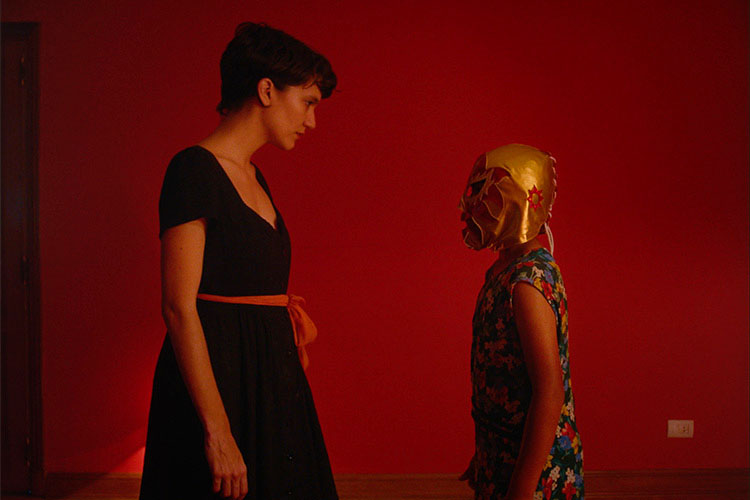
We interviewed Lorenzo Ferro on the occasion of his film “El Tren Fluvial”
Many of us knew Lorenzo Ferro by “The Angel”the film produced by El Deseo in which he starred. Many others continued their careers in the world of music, such as Kiddo Toto, or the crossover between both arts in the Netflix series “Fanatic”.
Lorenzo continued acting in films such as “Simon of the Mountain” and series like “The Marginal”but now he is moving on to directing, at least in terms of feature films, since he already had some short films and a couple of his music videos to his credit. For all these reasons, we spoke with him at the San Sebastián Festival, where he was presenting “The River Train”a film co-directed with Lucas Vignale, recently released in Spain.
How was your time at the San Sebastián Festival this time as a director instead of an actor, to present “El Tren Fluvial”?
I already knew the city, from when I was with “Simón de la Montaña” and “El Ángel”, and for me it is one of the best festivals. But having a film as a director was totally different… delirious, you could say. It was very nice, people received the film very well, I was able to go into the sea, I ate incredible… the fact that Lucas was not there also had its weight (NdR: Lucas Vignale, also director of music videos for Nicki Nicole or Bizarrap, died this year in a helicopter accident). That brought some pain to the premiere. It was presented in a beautiful cinema and people reacted very well, at least that alleviated a little the pain and strangeness of presenting a film without your partner. It was a mix of strange and beautiful emotions, a roller coaster. But very happy.
“We wanted a film that had soul, whether you like it or not”
Since this is your jump to directing, I wanted to ask you about references that you had in mind. I have read in other interviews that “Gloria” by Cassavettes was key, but I don’t know if something else was lurking around you. Also if you want to share references from Lucas, but, regarding that topic, however you feel comfortable.
Thank you, yes, Cassavettes was a reference for both of us. Specifically, “Gloria” had a big impact on me, in fact… (ed: he shows me a tattoo he has of her). I saw it as a child and it had a big impact on me. Also Luis Ortega, for seeing him work live and grow in a very important stage of my life with him. Federico Luis, the director of “Simon of the Mountain”, was a great reference for me and for Lucas. Leonardo Fabio was also a great reference for both. And then, there is a person who helped us a lot, he doesn’t even know it because we didn’t even talk to him, but it was Albert Serra. We went to see “Pacifiction” in a movie theater here, and when we left to see it, we said “We have to go out and film.” He is a person who encouraged us too much. Herzog too, his books… I don’t know, a million references.
There is very little dialogue in the film. I understand that your idea was to rely much more on the images, and also that the story be told through the eyes of Milo Barria’s character.
Completely. We wanted to have fun, we didn’t want to go into the ninety-page script of character development, you see? It was more “Let’s take a character we like, locations, what we have in our soul, let’s make a recipe with that, mix everything, and see what happens.” We wanted to do that experiment. In fact, we wrote the dialogue scenes the night before; In fact, in the editing, many were left out. We were finding the uniqueness of the film. We wanted to do something weird, like a mix between marbles and fireworks. Our little amusement park, a toy store, we didn’t want to make a very thoughtful film, where what is said is always very good… We wanted a film with black holes, that allows itself to doubt itself, because the filmmakers doubt themselves by making it. That that was also in the movie. But don’t doubt its uniqueness. One can doubt many things about oneself, but when one doubts one’s uniqueness, one is lost. If you trust your uniqueness, you will arrive at some good port. We wanted a film that had soul, whether you like it or not. If you finish watching the movie and you liked it or not, well, but if you finish watching it, I ask you if it has a soul and you tell me yes, I stay calm.
What was it like working with Milo, also having so much weight in the film? I think, for example, of those scenes that you wrote the night before.
Children have very good memories, I learned that while filming this movie (laughs). Also, many times, when filming, I would tell him “Say this”, I would wait three seconds, he would say it, I would wait three seconds, etc. When we turned on the camera, the camera captured what he has, see? That imprint through his gaze. What was a complication was keeping it fun while we weren’t filming. We had to play soccer or cards with him, also when he got tired of filming a shot we had to tell him “One more and we’ll go bowling.” We had to invent fun proposals so that he could be calm and give his best. Once we turned on the camera, it was already interesting what happened. And the more fun he had filming, the more he played, the more he played, the more the unexpected appears, the more the miracle appears. Without Milo, the movie wouldn’t stick, so we had to keep Milo for the movie to stick.
The film also relies a lot on the soundtrack, and being a musician I find it doubly interesting. How were you involved in its development?
Oniria is a person with whom I had already done my last work as a musician, he was also a good friend of Lucas, and what we did was send him a copy of the movie with references that we had put until we had the original music, and wait for feedback. He made five songs, and from that we ended up choosing just one, which is repeated throughout the movie, because we were excited by the idea of the leitmotif. I had also sent him an audio of Gurdjieff’s meditation, and it occurred to him to buy that instrument, which is the harmonium. He sent it to buy it from India and it occurred to him to record on cassettes, in analogue, that’s why you hear some strange things… It was very nice to work with him. Also a great inspiration was Bela Tárr’s musician and “Satantango” actor, Mihály Vig, who, after six months of sending him emails, we got him to make us a song. The piano that plays when Milo enters Rita’s house was played by him.
Were you clear about that ending? Milo’s sustained shot seems to me to be one of the film’s strong points.
Yes, in fact, that scene you mention was the first one we shot in the entire movie. It was a forty-minute take, very long, he began to enter a melancholic state and ended up crying, and I remember shaking my head and seeing the sound engineer crying, the cameraman crying… Since it was the first thing we filmed, the film started very well and we trusted Milo a lot from then on. Everything we started to put together afterwards was based on that image.
As we have said before, the images bear a great burden of “The River Train” by having almost no dialogue, and it has a wonderful photograph by Thomas Blabala. How was working with him?
The film’s director of photography had never had that role, he was a focus puller. We called him above all because of his qualities as a human being, and then we realized that he was a genius at photography. Lucas also framed a lot, I was really bad, I didn’t know the difference between lenses. We also had two cameras, one was sometimes used by Lucas, other times the director of photography… But the ideas, it was a lot of watching films, sending him films, and having the locations well studied. We had a very small camera setup, we could turn it on very quickly and move it easily, so that gave us a lot of freedom. And from the beginning we knew that we wanted to use a small camera so as not to intimidate the non-actors, and then transfer it to 35mm, which we sent to a laboratory in Romania. Another fact is that we also made the film in 4:3 because we didn’t have much money for art…
(NdR: at this moment, Lorenzo apologizes because he has to leave, and we send him two written questions that he answers by e-mail)
The last thing you released was the EP “Los cantos de la noche”, although I understand that the break after that has been a bit forced by the film. Are you considering returning soon, alternating with cinema, or do you want to focus on this for now?
For now I don’t plan to make music again. I feel that making films is a way of making music in some sense. Of orchestrating, of producing, of downloading ideas and communicating them to a rock band, of film jazz. At least for me. But yes, I feel a little uneasy with the idea of going to a studio to rap or sing. Although the desire to make an album is always going around, for now I don’t see it close.
You told me that Oniria had already produced you before. Aside from him, are there producers you’d like to work with that haven’t happened yet?
Whether for future songs, or for the soundtrack of another future movie, of course. Now I’m obsessed with Zbigniew Preisner, the musician behind the soundtracks for Krzysztof Kieslowski’s films. I would love to work with him on my next film. And I also really want to work with Oniria again, I have been very satisfied with the results of “El Tren Fluvial”.