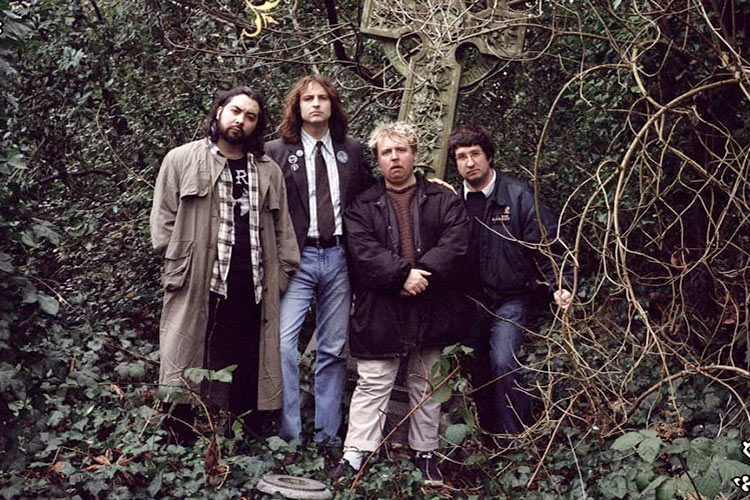
“I wouldn’t want to be in the spotlight like Geese”
The British The Tubs They are one of those timeless bands that with the classic elements (guitar, bass and drums) look for that chimera that is the perfect pop song, following in the wake of bands like The Smiths, REM or Teenage Fanclub, as clearly demonstrated “Hard Life” (Merge/Popstock!, 26), their third album.
The Tubs They do not hide their influences, although they are a little tired of being the only ones who are blamed when “There are a million bands that sound like Life Without Buildings without anything happening, because what they are copying is much darker and unknown…”. I chat with the band’s leader, Owen Williams, about their third album, “Hard Life”. He is someone affable and with his feet on the ground, his dream in music is to achieve “stable operation.” There are many bands dreaming of being the new Beatles, but The Tubs are not among them, they prefer to avoid the main focus and build a career “Dinosaur Jr. guys who can put out the same kind of record and people are happy about it.”
“I like to be one disc ahead so I don’t have too much pressure”
When I ask him if he thinks there is a new resurgence of guitar bands with groups like Fontaines DC (who recently praised them in an interview with Rolling Stone) or Geese, he tells me that there may be one. “a certain narrative about that, especially with Geese or Charli XCX making a guitar or rock album”, but those bands are a little more “post-punk or experimental” and that the more melodic or classic bands like them are still not in fashion, although he admits that the Lemon Twigs are a little bit. But Owen Williams doesn’t feel bad about it, he almost prefers it, he assures me that as a teenager he played in shoegaze bands when no one paid attention to the genre and that now that there is a ‘jangle’ band that genre has become fashionable again, but that it’s always their turn. “where fashion is not.” Then laughing he tells me that he prefers it, “I wouldn’t like to be in the spotlight like Geese, there is a lot of attention paid to them, it is most likely that in five years the narrative will have changed and they will say that they are on the downhill. But if you don’t go too high then you can’t fall off the cliff either.”
He also recognizes that, in his composition method, despite being a brilliant lyricist, the melody comes first, and then the lyrics have to fit into it. “My theory is that it’s much harder to write a good chorus if you start with the lyrics first.”. Of course, he always looks for a contradiction between those bubbly and luminous melodies with much less friendly lyrics, bordering on the self-flagellation of his own character, and he admits that it is something sought after. “You can have harsh words and say brutal things, but the music acts as a contradiction, it sounds almost happy, which complicates the lyrics even more. If you write a positive song or a sad song that also sounds sad, you don’t achieve that strange tension in the same way.”
His references are clear, and Williams does not hide them. When I ask him about the composers who have come closest to writing several perfect songs, he points out Fleetwood Mac, recognizing his weakness for Christine McVie, and Teenage Fanclub, of whom he comments that “They were very good at it and they are too underrated”and finally, he recognizes that his favorites are, without a doubt, The Smiths. “I remember when I was very young, going in a car with some friends and they played that compilation of The Smiths that is like a greatest hits, I don’t remember what it’s called, and there are twenty perfect songs in a row. For me they have always been the reference.”
So much so that one of the most talked about things about this album, the manipulation of his voice in some tracks for that “cipmunk” sound is based on those of Morrissey. “I was influenced by ‘Bigmouth Strikes Again’ by The Smiths, so I decided to put it on some tracks, but I didn’t know it was going to be so divisive and controversial. So I think I should put out a version of the record without the ‘chipmunk’ vocals.”
Regarding the specific influences of this album, he tells me about some less obvious names, such as Elliott Smith, “in the two acoustic songs” and the early Paul Weller of The Style Council, on songs like “Now And Then” or “Who’s Gonna Love You Now?”. “I was trying to do my own version in that very soulful way of singing there.”
His favorite albums leave no doubt about the importance of the song, “I start with “The Queen Is Dead” (The Smiths), “Heaven Or Las Vegas” (Cocteau Twins), “Reading, Writing and Arithmetic” (The Sundays), “Ghosts Of The Great Highway” (Sun Kill Moon), “Grand Prix” (Teenage Fanclub), “Come On Feel The Lemonheads” (The Lemonheads), “Solyd Air” (John Martyn), “Blue” (Joni Mitchell) and “Car Wheels On “A Gravel Road” (Lucinda Williams).
Finally, he surprises me by saying that he has already written the next album because “I like to be one disc ahead so I don’t have too much pressure”. When I ask him what it’s going to sound like, he tells me that he’s been listening to one of his favorites lately, The Sundays, and his modesty and sense of humor come out again. “I imagine it as a slightly faster version of The Sundays, which can end up sounding horrible.”