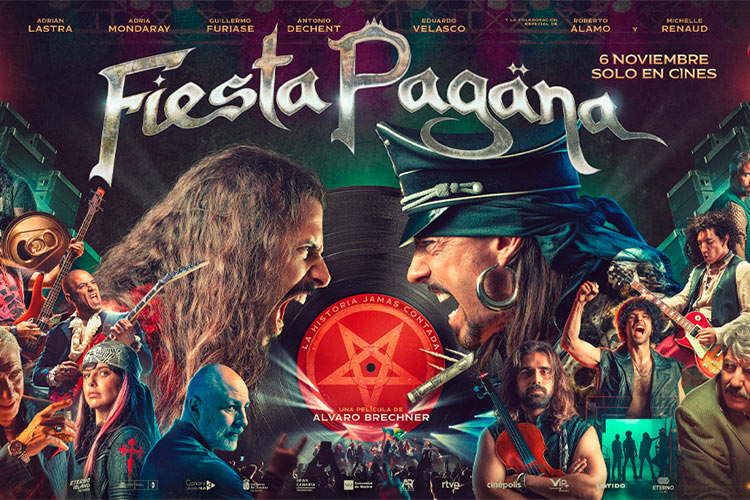
We review ‘Fiesta Pagäna’, the biopic of Mägo de Oz that premieres this Friday
When it was announced in 2023 that a biopic about Wizard of Ozall the alarms went off: Is it necessary? Will you rise to the occasion? How are you going to approach all the disagreements that the band has faced throughout its history?
After all the new controversies that the production itself has generated, with the group itself launching statements to disassociate itself from the project and trying unsuccessfully to put a stop to it, a few months ago we were able to see the first trailer. Here many doubts have already been cleared up: the thing was serious, now it hits the screens, and it may even work.
“Pagan Festival” shows the archetypal story of a music group: how a handful of neighborhood kids get together to play, achieve unprecedented success (especially being a Spanish heavy metal combo that also includes folk instruments like the violin or the flute; or maybe precisely because of that) and fulfill their dream of being rock stars (contracts with multinationals, massive concerts, international tours…).
The production is sustained thanks to the good characterization of the protagonists (especially that of Adrián Lastra as Txus di Fellatio, although we always miss actors who really know how to play the instrument in their hands), a credible recreation of their performances and adventures (concerts in Las Ventas or Mexico actually filmed in various locations in Madrid and the Canary Islands), and a story that maintains the rhythm thanks to the endless epic anecdotes and the songs of Mägo (which doesn’t stop ringing).
The main problem with the script (written by Sofía Cuenca together with the film’s director, Álvaro Brechner) is that it abuses the clichés regarding rock and heavy metal: unscrupulous managers (very good Antonio Dechent playing ‘Goyo’ from Locomotive Music and Eduardo Velasco doing the same with ‘Tibu’), musicians without stopping drinking, smoking and consuming cocaine (ignoring other aspects as interesting as the composition of the songs, which here they seem to write themselves), and absence of relevant female characters (the three women who appear barely say four sentences). It is not much different from “This is Spinal Tap”Oh.
Although it seems that what has bothered the band members the most is the special emphasis they have placed on their internal conflicts, centered on the duel between Txus di Fellatio (main composer, drummer and band leader) against José Andrëa (singer played by Adrià Mondaray). “We never wanted a film in which the focus would be on past controversies. We do not agree that a film about a band with almost forty years of history should emphasize past controversies with former members of Mägo who cannot defend themselves or give their opinion,” the band would say in a statement at the end of 2024.
However, the fact that it did not cut corners when telling the story in this way prevents the film from being as sugarcoated and disguised as other authorized biopics of the type. “Bohemian Rhapsody”. Álvaro Brechner (winner of the Goya for Best Adapted Screenplay for “The Night of 12 Years”) has managed to carry out a production with many factors against it, end the narrative in a good place (the departure of José Andrëa and company’s group) and offer with the budget he had in his hands a biopic about a national rock group with more dignity than average (it was not very difficult either, given the few productions of this type that exist). Go see it, and draw your own conclusions.