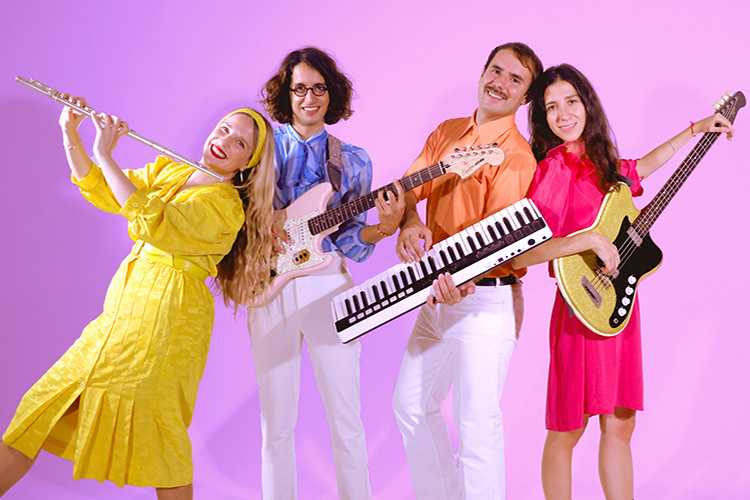
Adrià Arbona’s favorite soundtracks from Papa Topo
Adrià Arbona, leader of Papa Moleis not only one of the best pop composers in the country, but he has also stood out in the world of soundtracks by signing the music for various films by underground filmmaker Marc Ferrer.
Taking advantage of the fact that his group will be playing next Friday, July 31 at the Low Festival in Torrevieja, we have asked him to choose his favorite soundtracks and this has been the result.
“The Umbrellas of Cherbourg” (1964) by Michel Legrand
The collaborations between director Jacques Demy and composer Michel Legrand are sublime. “The Umbrellas of Cherbourg” It is something like a cinematic pop opera, all the dialogues are set to music and wrapped in lush orchestrations where the music covers the film from beginning to end. Legrand has the ability to make very complicated music, both melodically and harmonically, that, surprisingly, is very easy and natural to the ear. The soundtracks are also beautiful. “The Ladies of Rochefort” (more jazzy and close to the classic musical) and “Donkey skin” (it is much darker and with a predominance of old and convoluted musical forms such as the fugue).
“The Hours” (2002) by Philip Glass
The soundtrack composed by Philip Glass for “The hours” by Stephen Daldry is also one of the music that had the greatest impact on me as a child. I went to see it when I turned 11 and it was a before and after for me. Being so young, the film had a great impact on me because of its theme (three lesbian women who live in different time plans and go through very difficult experiences marked by suicide, abandonment and illness), but also especially because of its music. Glass made something like a minimalist review of chamber music from the late 19th century (very appropriate for this mix of anachronistic styles in a film with various temporalities). Despite being a fairly happy child, I became obsessed with this deeply melancholic music, I bought the CD and the sheet music, and spent months playing them on the piano.
“Manuela” (1976) by VV.AA.
A director who fascinates me, among many other things, for his use of the soundtrack is Gonzalo García Pelayo, whom I discovered years ago when a cycle was dedicated to him at the Barcelona Film Library. García Pelayo, although he is famous for having developed a method for playing roulette and poker, is an extremely free film director who made many low-budget films, but with enormous imagination about Andalusian culture. He also exploited his fascination with Andalusia as a music producer and promoter of Andalusian rock from the seventies, promoting the music of, among many others, Triana, Lole and Manuel and María Jiménez. In his debut “Manuela” Many of the music he produced appear, and in it are some of the most beautiful musical scenes that I remember in Spanish cinema. The sequences that I remember most vividly are one in which a woman dances to the sound of Triana a zapateao on top of a tomb, and another in which aerial images of dawn in Andalusia are seen while “Nuevo Día” by Lole and Manuel plays.
“But I’m a Cheerleader” (1999) by VV.AA.
A really fun movie with which I discovered a lot of cool bands. It is a 90s black comedy about a seemingly “perfect” American entertainer in the eyes of society, who enters conversion therapy to try to leave her lesbian inclinations behind (evidently, it doesn’t work). Many groups led by girls appear on the soundtrack, both indie pop and riot grrrl: Go Sailor, Dressy Bessy, Saint Etienne, April March… All of these bands have a naive and ironic character, but they are at the same time markedly feminist and countercultural. The musical selection, then, matches perfectly with the tone and subversive message of the film.
“A Charlie Brown Christmas” (1965) by Vince Guaraldi
This past Christmas I saw the Peanuts Christmas special for the first time, “A Charlie Brown Christmas” and I loved it in part thanks to the music. The Peanuts universe is a seemingly innocent and naive world, but it harbors a lot of sadness, anxiety and depression. Some of the characters are cruel, others are deeply sad, but there are always glimmers of hope and childlike naivety. The music that Vince Guaraldi made for the Peanuts television specials perfectly conveys that duality. It is simple and somewhat childish music, but it also has a very important melancholic tone.
For the Christmas special he wrote the famous Christmas carol “Christmas Time It’s Here”. I read that to record it they hired a professional choir of child singers, but since they sang “too well,” they made them repeat the song countless times until they were already singing tired and many more imperfections, out of tune, and so on appeared. With that, Guaraldi wanted the choir to look like a group of children who spontaneously get together to sing Christmas carols, thus transmitting a very fine fragility that moves me a lot.