
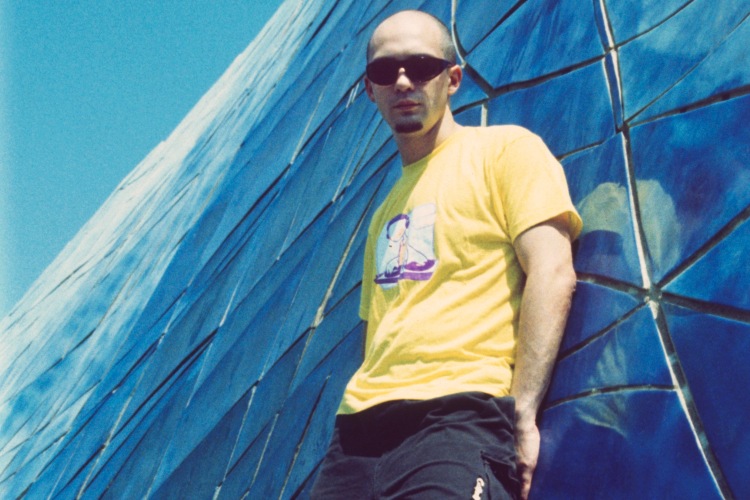
30 years of the album “Palais”
Published in 1996, “Palais” It was one of the albums that showed that state electronic music could look beyond the dance floor. With a vision that integrated techno, electro and sound exploration, Madelman He signed a work that became a cult reference over time.
Thirty years later, the album returns thanks to Cosmos and Austro-Hungarianas “IDEM PALAIS”. A revised edition (edited, mixed and with a new master) that is released for the first time on vinyl.
I owe everything to the 90s. My development as an instigator (DJ) and major interest in the giant steps that this planet took in terms of the development of electronic sounds and club culture. England, Germany, the United States monopolized the controls of some ovens that did not stop cooking and suggesting crazy things to us… Meanwhile, in Spain, a kind of “silent revolution” began to take place led by great DJs like Ángel Molina, Oscar Mulero, Cristian Varela…or precursors of the rhythm broken by my southern land like Ale Baquero either Jordi Slate. Some of them with wonderful virtues also when they locked themselves in the studio to produce (HD Substance, Álex Martín, Prozack).
That said, Madelman (José Luis Rebollo) occupies an exceptional place in the history and development of said Spanish electronic scene. Far from the dominant trends of the mid-nineties, the man from Bilbao imagined a music that looked as much to techno and electro as it did to celluloid, science fiction and home listening. The result was “Palais” (Cosmos, 1996) a personal and ambitious work that would end up becoming a cult reference.
You did the math, right? That’s right, the 30th anniversary of one of the first albums in our State to claim the long format as a narrative experience has just passed. Its synthetic landscapes, its evocative melodies and its refined production – without the need to innovate in technologies – placed it in its own territory, closer to the tradition of Orbital, The Orb, LFO, Yellow Magic Orchestra or even Kraftwerk than to the immediate logic of the dance floor. Temarracos like “Sport Shoes” or “Eurovisible” definitively related us to the rest of Europe, later they turned us into a little light to bow down to for the rest of the world. Our interest in techno, kraut, electro and other exploratory niceties was proven. And I repeat, not in singles. compilations or 12”, but everything very well fitted, told, within the same LP.
“The unexpected thing was discovering the reception my music had when I played live at the Sónar festival in 1995 and I confirmed the value of what I was doing at home, in Bilbao…”
Now, coinciding with that 30th anniversary, Cosmos, Austrohúngaro, and of course Madelman himself, invite us to rediscover an album that time has treated with extraordinary generosity. What was once a discreet gem appears today as one of the visionary works of Spanish electronic music of the nineties.
Ah, before extracting a few confessions from the author himself, I cannot forget that the revised edition based on the original materials for the anniversary is titled “IDEM PALAIS” (Cosmos / Austro-Hungarian, 2026) becoming the first time that this cult work comes out on vinyl.
Madelman is not a name as high in the media as others of his generation, but precisely for this reason exploring his most personal perception leads us to know how important it was for him to open his mind to explore. “When I arrived at the Faculty of Fine Arts I had already been experimenting with sound for some time. I was working from a noise and experimental perspective, using dismantled radios, a monophonic synthesizer and instruments invented by me.” It was in that context where he met Juan Flahn, “with whom I shared a very casual vision of the world of pop. We had fun inventing imaginary groups and talking about them as if they existed. That complicity gave rise to a work team with which we made music, comics, videos that we often presented as class projects.”
Years without a doubt to study the tentacles of art and for total immersion. And so it continued until it was published “Palais” which achieved an impact that was as unexpected as it was, ultimately, desired? “The unexpected thing was discovering the reception my music had when I played live at the Sónar festival in 1995 and I saw the value of what I was doing at home, in Bilbao… I came into contact with Cosmos Records, I met Alaska, Nacho Canut and many artists, and I began to understand that what I was developing in a fairly isolated way had space and meaning within an electronic and dance scene that was beginning to take shape.” Um, I didn’t mention it at the beginning, but as he pronounced these names, another producer came to mind, the Madrid-based – with permission from Paris – Big Toxic.
Precisely in Madrid he opened for Aviador Dro, participated in several compilations and finally, he received a firm proposal from Cosmos to record and release an album. From what he tells us, the ideas were clear from the first moment, even with that already iconic cover! “Both the sound and visual approach of the project was very advanced: the minimalist image of the athletics track on the cover, some well-crafted sequences and a repertoire that worked well both on record and live. More than a surprise, it was a matter of synchronicity.”
And although the then boy grew up with songs from the seventies and eighties (light music, disco, pop) “I always felt the need to look for something more experimental. I was especially attracted to electronic music, the idea of independent people creating sound universes with their machines. Figures like Laurie Anderson were fundamental for me. I have always been fascinated by the discovery of new sounds, of timbres capable of appearing for a second and capturing all your attention.”
I praise this interest in those who are capable of proposing new sounds, instead of feeling safe and settling into the familiar. “That’s why groups like Visage, Propaganda or LFO had such an impact on me. For me, making music is about relating sounds. You place one next to another and it’s inevitable that they start to dialogue with each other. When that happens, when a sound really works and finds its place alongside the others, something like a perfect emulsion is produced: small independent units that suddenly form something new and coherent.”
Although some might think otherwise (me included) “I never really stopped Madelman… What I did was stop acting to concentrate on the development and recording of new repertoire. The problem is that the process was lengthening, other projects appeared and little by little my activity was moving towards other areas… During those years I continued signing remixes for artists like Fangoria, Astrud, Enrique Bunbury or Carlos Berlanga, and later, working on musical composition for installations and projects by artists like Txomin Badiola, Dora García or, more recently, Manu Arregui.”
Finally, and after discovering the proximity of his talk, how will he now receive, in the middle of 2026, the departure of “IDEAM PALAIS”. “It represents a new look at material that still makes sense to me. I had the need to go back to those recordings, review them and propose a new mastering that incorporates alternative takes and versions that had been left out of the original edition.” An idea that was generated in the summer of 2015 and began to be developed in 2016. But what often happens, “For different reasons the project was postponed again and again.”
Madelman’s words: “It is a very special album for me because it reflects a way of working that is difficult to imagine today. Compared to current production methods, it was an extremely laborious process. Much of the work consisted of constantly optimizing resources. The album was made with a workstation that had just two megabytes for sequences and samples, a very limited capacity even by the standards of that time. This forced us to continually make decisions, save data, which turned the production into an artisanal process.”
A marvel, and I say this while one of my favorite songs plays in the background: “Sport Shoes”. And oysters, we agree on this idea: “It is probably the version of the song that I like the most of all the ones that have existed. It has something that the Palais version had lost along the way: a certain quality of an electronic ballad, more contained and melancholic, which connects directly with the original idea of the song.”
When electronics and good intentions become a kind of religion. Amen, and little more to add.
