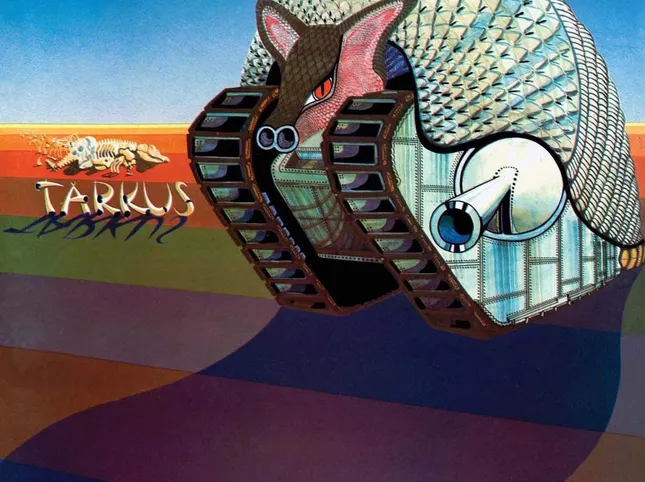
What remains today of Emerson, Lake and Palmer’s “Tarkus”?
On paper, Tarkus – the second album by Emerson, Lake & Palmer (ELP) – he is 55 years old (released in June 1971). In headphones, it’s a monolith that survives the passage of time unscathed. What remains of this masterpiece today? The technical audacity remains, the unforgettable iconography remains and, above all, it remains a warning about an out-of-control war technology which, in the age of drones and artificial intelligence, appears prophetic.
Between chance and genius
The imagination of Tarkus was born almost by chance. The artist William Nealtasked with proposing ideas for the cover, had scribbled in the margin of a sheet of paper a bizarre hybrid: an armadillo fused with the tracks and cannons of a tank. When Keith Emerson saw that sketch, he was struck by it. He had just sketched out a complex and martial rhythmic framework in 5/4, but he lacked a face for that music. That doodle gave a name, a shape and a narrative direction to the entire project. The monster became the perfect metaphor for the futility of war and for the inevitable clash between nature and cold, mechanized and destructive technology.
A monumental suite
The entire first side of the original LP is taken up by suite of the same name lasting over 20 minutes. It is an unprecedented musical and narrative journey, in which the monster is born, fights against deities and mythological creatures (the Iconoclast, the Manticore) and finally, wounded, retreats into the abyss. A suite considered (rightly) one of the absolute peaks of progressive rock for its cohesion and narrative impact.
In EruptionTarkus rises from the volcano, a synthesizer-driven instrumental tour de force in frenetic 5/4 time; Stones of Years it is the first section sung by Greg Lake, a melancholy elegy and a harsh criticism of human blindness in the face of conflicts; Iconoclast it is a tight instrumental clash, where Tarkus advances, destroying all resistance and false idolatry; Max it is instead a sarcastic attack on religious hypocrisy, supported by an edgy riff and a harsh vocal line; Manticore takes its name from the only creature capable of challenging and defeating the machine, the mythological hybrid Manticore; Battlefield represents the epic and tragic final battle, dominated by a rare and poignant electric guitar solo by Greg Lake; In the end, Aquatarkus it stages the retreat of Tarkus, defeated but not destroyed, into the depths of the sea, accompanied by a solemn march with an almost military flavour.
From tragedy to irony
While the suite takes on all the conceptual weight of the album, the B-side shows the versatility and, at times, the irony of the trio. After the titanic labors of Tarkusthe band needed to let off steam with shorter, radically different songs. Bitches Crystal it is a frenetic and dark piece that mixes jazz, boogie-woogie and dissonances, a perfect example of the rhythmic independence in the hands of Keith Emerson on the piano.
The Only Way (Hymn) / Infinite Space is a direct homage to Johann Sebastian Bach (the melodies incorporate fragments of Toccata in F major and of Prelude VI). Here Emerson plays the real pipe organ from St. Mark’s Church in London. Are You Ready Eddy? is a hilarious and ramshackle 50s rock and roll recorded practically live, dedicated to their brilliant sound engineer, Eddy Offord. Proof that, despite their reputation as serious and academic musicians, ELP knew how not to take themselves too seriously.
What’s left of Tarkus?
We could say that the legacy of Tarkus moves along three fundamental lines: let’s start from thematic prophecy. The figure of the armadillo-tank is the embodiment of an unstoppable war machine with no morals. In an era dominated by discussions about autonomous weapons, combat drones and artificial intelligence applied to conflicts, the warning of Tarkus it is disturbingly current. Humanity being crushed by its own armored creations is a metaphor that hasn’t aged a day.
The second factor is lo absolute technical standard. The album redefined the role of keyboards in rock. Before Tarkusthe Moog synthesizer was mainly used for sound effects or atmospheric carpets. Keith Emerson transformed it into a solo instrument capable of rivaling Jimi Hendrix’s electric guitar in aggression. The polyrhythm between Emerson and Carl Palmer’s jazz rock drumming continues to be studied in modern music conservatories.
Finally, let’s consider the impact on pop culturebecause the visual and musical aesthetics of Tarkus he crossed the boundaries of rock. Video game soundtrack composers such as Nobuo Uematsu (Final Fantasy) And Koji Kondo (Super Mario, Zelda) cited this album’s harmonic progressions and synthesizers as direct inspiration for the music of “end-of-level bosses” and epic battles in Japanese role-playing video games.