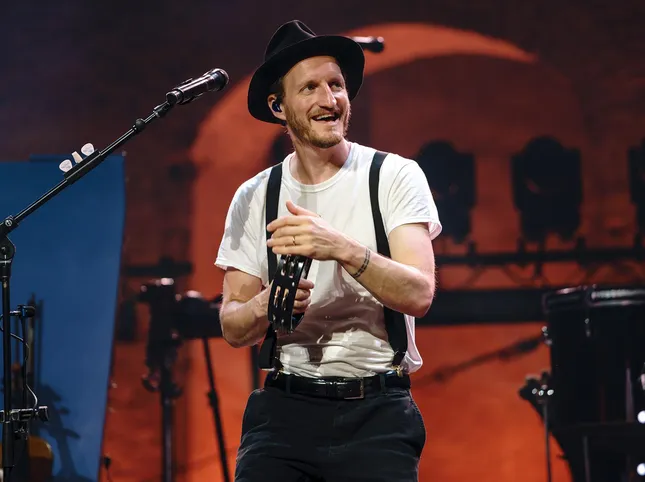
Jeremiah Fraites: “I felt a connection with Springsteen”
Multi-instrumentalist and co-founder of the group The Lumineers, Jeremiah Fraites he is an artist capable of oscillating between the oceanic stages of large stadiums and the absolute intimacy of instrumental music. While waiting for the band’s return to Italy, which will play atVerona Arena the next one July 6we asked Jeremiah (now Turin by adoption) to tell us about his multifaceted artistic evolution.
In recent years, Fraites has also established himself in the world of cinema, writing the intense soundtracks of The Long Walk and the biopic Springsteen: Deliver Me from Nowhere. Acting as a common thread in this emotional journey is his faithful “Firewood”, an old piano that has become special precisely because of its raw, woody and imperfect timbre: a unique instrument capable of stripping music of every great production to restore its pure melodic soul.
You described your solo work, Very quietlyas a vulnerable project where you can’t hide behind a singer’s voice. Considering the immense stages you’ve played with the Lumineers, is instrumental composition a way to find your center again?
It was like that. I don’t know whether to use the word “escape”, but I perceived it as a need, as an obsession or something I had to do. I co-founded the Lumineers 21 years ago with singer Wes (Wesley Schultz, ed.). And when we started, I could barely play the piano. I mean, I didn’t really know how to play it. I learned, I kind of taught myself how to play, slowly, over the years. Then, during COVID, we were on tour with the Lumineers in the US, and everything got cancelled. So I moved back to my home in Denver with my wife, Francesca, who is Italian (which is one of the main reasons I now live in Turin). And she said, “Well, why don’t you make that album now?” And I was like, “Okay, I can try,” because we knew we were going to be in the house for many months. So I started recording that album.
As we were finishing it, my original idea was to call it Jeremiah Fraites’ Piano Compositions, Volume One. And she said, “Why don’t you call him Very quietly?”, which in Italian means little by little, or step by step. And I thought, “How cool, what a great name!” Because it refers both to the piano instrument and to slowness. I love this name. And it was an interesting way in which we started working together: she had helped organize the Lumineers’ very first concert in Milan in July 2013 and was working in the music industry. I then credited her as executive producer of Plan Plan 2 and later we also did two film projects together.
I felt that first album was a deeply vulnerable work. I knew those ideas wouldn’t work for the Lumineers, they seemed very cinematic to me. I wanted to do something just focused on the piano, without too many strings, without drums. I really wanted those listening with headphones to feel like they were sitting on the piano bench next to me. It was pretty raw and vulnerable, yeah.
Turin is a reserved city, very far from the logic and rhythms of the American music business. Did it help you on your journey?
I think the thing I love about living in Turin is its tranquility. It’s not crazy chaotic like Milan, Rome, New York or Los Angeles can be. It conveys a sense of peace, and I love it. I travel a lot, so when I return to Italy I don’t work and I can simply relax. I think life in Italy has made me happier. I think it helps me find inspiration when I return to America to write or work on other projects. I’m really happy here in Italy.
Turin is not Nebraska, but is it this need for intimate dimensions that brought you closer to Springsteen’s album?
It was an interesting thing. I had been in Denver, Colorado, for about a month rehearsing the new Lumineers album. My wife and our children were at home in Italy because the children had school. So I was there alone and I started writing all this music, hoping to send material to Springsteen’s team, having grown up in New Jersey listening to Bruce. I was completely alone in that house in Denver, coming back in the evening after a long day of rehearsals and it was all very dark and private. I just felt inspired to write music that I felt would be perfect for the film. It seemed like a strange connection: being alone and trying to translate into music that sense of loneliness Springsteen felt when he wrote Nebraska.
Nebraska It’s a very difficult record to approach due to the context in which it was born and the emotional charge it brings with it. Has he ever intimidated you?
To be honest, I felt more intimidated on the red carpet in New York! Before that, I don’t think I ever thought about pressure. I just thought, “I’m making music that I like and that I think serves the movie and the character.” Then, at the New York Film Festival, there were the producers, the director and the actors, Jeremy Allen White and Jeremy Strong. And when I saw Bruce Springsteen walking down the red carpet, I was like, “Oh shit, I hope I did a good job!” It was at that moment that everything suddenly took on weight. I said to myself, “Okay, now I feel the pressure. Now it’s real.”
Bruce recorded that album with little means. You have an old piano, “Firewood”, which reminds me of that atmosphere a bit. Do you think music is at its best away from big productions?
No, I don’t think so. Depends. Nebraska it worked so well precisely because it was so raw and had bare-bones production. My favorite band, Radiohead, thrives on insanely complicated production and they do it so well. Take Bon Iver: with the first album, For Emma, Forever Agothey fooled the listener into thinking it was a small production. It looked minimalist, but the sound of the guitar, the details… behind their essence, there was a great production work. The White Stripes also seem like a stripped-down band, but what I love about the production is when the artist gets it right, creating a sound that’s unmistakably his. Think of Billie Eilish, Radiohead, or even John Williams: impressive orchestrations, but you immediately know it’s him. For NebraskaBruce remained true to his ideas and found his voice in simplicity, fighting for it. When I wrote the soundtrack for the Springsteen film, I also wanted a contained production, but without imitating it Nebraska using old guitar sounds. I wanted to find my voice in a complementary way.
Do you think this experience will have an impact on the music you make in the future? Has it changed anything?
What I love about solo projects is that they keep me creative; I’m truly at my happiest when I create something. It evolves my sound: when I write for the Lumineers, sometimes I think “this would be great for a film”, and vice versa, working on a film, I write something and say “this would be great for the band”. It keeps me inspired, constantly searching, and makes me evolve as an artist and as a human. I think it’s a really healthy mechanism for me.
The Boss was born as working class hero. Do any still exist? There is an artist that you consider your own hero?
It’s a good question. I couldn’t name it working class hero among today’s musicians, although I’m sure there are some. Bruce is certainly the absolute emblem of this. If I had to choose a personal hero of mine, I would probably say Jonny Greenwood. I love what he gives to Radiohead and I love his solo work, especially the soundtracks. He developed a sound based on strings and orchestra, but in a unique and never-before-heard way. I also really respect the fact that he makes few films, choosing only projects that really speak to him and that he loves deeply.
As a pianist you are very close to Beethoven.
For me it’s great. When I was little, my mother Kathy bought my brother and me some cassette tapes at a department store in New Jersey. One was for me: it was the Sonatas by Beethoven mixed with sounds of nature (birds, frogs, the ocean, the rain). For my brother he bought Mozart. I remember we argued about who was better, and I argued that Beethoven beat Mozart. It’s funny: obviously Mozart is a genius, as is Bach, but I don’t necessarily like listening to their music. I viscerally love Beethoven. It got into my blood from an early age. Every evening, for years, I listened to that cassette before sleeping, so much so that at a certain point the tape became almost transparent due to wear. That cassette changed my life, and honestly, listening to it every night for about ten years probably helped me learn to play the piano. His melodies are crazy, incredible and interesting.
When you play the drums you are the backbone of the song, while on the piano you become its melodic soul. How do these two musical hemispheres communicate with each other?
Having started on drums before moving on to piano and guitar, I think I’ve always maintained a strong sense of rhythm. So, when in the studio I switch from playing and writing drum parts to piano parts, it’s very interesting because I make these two worlds communicate, combining their ideas. Live, being the drummer is exciting because you drive the beat; it feels like you’re steering the boat or driving the car. The fretted instrument, on the other hand, is more like paint: you can paint melodies and emotions, deciding exactly where to let the sadness or happiness enter. I feel lucky to be able to manage both at the same time. By having a clear understanding of what the drums do, I can write for the piano with a better perspective (and vice versa). I deeply love this synergy.