“Sit down with empathy”: why James are a unique band
“The Jameses are one unusual band. You missed something. You were looking away,” says Tim Booth.
The voice is calm and warm: even via Zoom it doesn’t sound very different from what you hear in James’ concerts and songs. In Italy, however, we have heard little of that voice: James are one of the least classifiable English bands of the last forty yearsa very long career, sold out arenas, hits at home and a popularity that continues to grow. With us only a few concerts in the 90s (which he struggles to remember), a date in 2014 at a strange Umbrian festival. On July 4th they will return for the first time in 12 years, to Peccioli, Tuscanyfor the “Le Canzoni” festival organized by Il Post. “It’s your chance to recover something quite unique,” Booth tells me. “We’ll see the place, we’ll decide the setlist on the spot. We’ll play our most famous pieces, but we’ll be inspired by what happens. I can’t tell you what to expect, we don’t know either.”
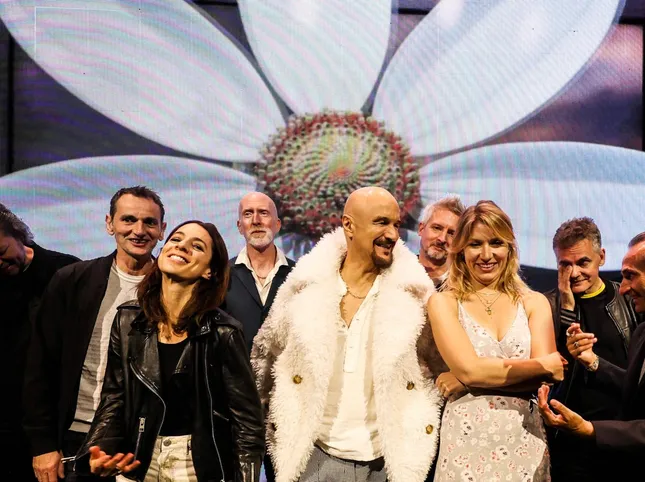
What makes James unique is the approach: songs with great melodies, which arise from jams and improvisations by 9 musicians; a band that changes every night, that continues to behave more like a collective than like a car with automatic transmission. A great sound and lyrics that convey empathy and humanity instead of British irony and detachment. So much so, Booth tells me, would change the lyrics of “Sit down”, his most famous song: “I wish I had sung ‘Sit down with empathy’, not ‘in sympathy’: we need awareness of others”.
Because the Jameses didn’t become Coldplay or U2
James have been around since the ’80s: born in Manchester, they had hits with epic pop-rock songs like “Sit Down” and “Born of Frustration”, but while Britpop exploded they deviated their sound and trajectory, experimenting with different genres. They could have occupied a space similar to that of U2 or Coldplay but, he explains, “The thing is, we’ve always been stubborn. When the James were at their peak, we headlined Reading, which was huge. We played b-sides and did ‘Sit Down’ as the third number. And I said something like, ‘If you came for that song, you might as well go home.'”
The Jameses are “Bloody minded,” Booth tells me, and he repeats this several times in the interview. Stubborn. “We gambled our moment of success. I watch Coldplay, I know Chris Martin: he is so elegant in his way of experiencing fame. He always says yes, keeps moving forward, keeps getting bigger. I think maybe we should have done that too. Instead we did the opposite. We kept saying no. We continued to be grumpy and difficult. And so here we are.”
So, despite being regular chart-toppers, their first number one studio album only came in 2024, with “Yummy.” “We knocked Beyoncé out of the top spot, pretty funny. I really like Beyoncé, too. Then the next week Taylor Swift knocked us off the top.”
The complex relationship with discography
In the ’90s, Booth tells me, he had a fight with a French record company that swore to put a spanner in his works in other European countries too. Booth explains to me that this is probably one of the reasons why they never had much of a following in Italy either. I asked a friend who at the time worked at Polygram, their Italian label: he has no memory of such a situation, but he confirmed to me that working with the James was not easy, confirming what Booth calmly tells me today. “We were quite hostile towards the record companies. We wanted our independence.”
And I’m still like this today: yes they produce the albums themselves and, he explains to me, “it’s all in our hands, from the songs to the setlists”. And it works: the James are experiencing a new season of popularity and musical creativity, with a sound that continues to bring together pop, rock, electronic and orchestral arrangements. In “Yummy” there are masterpiece songs like “Way Over Your Head”, which show a band at its peak. A documentary on their story, strictly self-produced, will be released soon.
A band that writes like no other
If James escapes definitions, it’s also because of the way they write: they don’t have a precise and repetitive sound, and that’s intentional. Three times a year they meet in a villa in the English countryside: “We improvise six hours a day. The songs in the jams that sound a little too much like James we tend not to work on. Each of us has a different sound, everyone has different tastes”, he tells me.
Even if there are some recurring elements: Jim Glennie’s melodic bass, multi-instrumentalist Saul Davies’ violin, Adrian Oxaal’s guitars, Andy Diagram’s trumpet. For a few years there has also been a second drums/percussion and Chloe Alper, Booth’s second voice and counterpart. “Most of us have been together for more than 30 years, even with different experiences and visions. It’s not bad, if you think that some bands last a few years.” Although the latest tour follows a greatest hits, they included an unreleased eight-minute song in the setlist, just written in one of these sessions. “And we will also play it in Italy, the public really liked it”.
“Sit Down” and empathy
What defines the James is the charismatic figure of Booth, as an author and as a frontman. From “Sit Down” to the recent “Way Over Your Head”, James’ songs have a sense of empathy that runs counter to the detachment and irony associated with many British bands. In “Sit Down” he invites those who feel sad, crazy or ridiculous to sit next to him “in sympathy”. “I wish I had sung with empathy. There sympathy has a sense of pity. Empathy, on the other hand, involves knowing that it could be you on the street, in Palestine, or you in Iran, and that’s what we need.”
“We’re not the kind of band from Manchester with the ‘I don’t give a shit’ attitude, whether it’s real or not,” explains Booth. “It was never really our way. James is a working-class band, but we like the contrast between aggression and beauty. Our music starts from the fact that the world is a tough place: we are realistic but we want to lift people up. It’s not just pop, joy and love. It’s kind of love with teeth. It has to have teeth.”
A sense of empathy and strength that also transfers to the stage, where Booth dances like a dervish and throws himself into the audience. He tells me that she has studied dance and practiced meditation for decades. “We don’t say it much because it’s not very rock’n’roll, but it helps me. The other night I went dancing for two hours and afterwards I wrote the lyrics to a song incredibly easily, when it can often take me days.”
From Brian Eno to Bruce Springsteen
If there is a record to recover in the career of the James is “Laid”, from 1993: the band deviated from epic pop towards a more acoustic and minimal soundwhich also yielded their biggest American success with the title track. There was production Brian Enowho had already changed the trajectory and sound of U2, and would later do the same with Coldplay.
“Before we met Brian we had already had some success and developed our own process, but he validated what we were doing. I remember when we were working on ‘Sometimes,'” Booth says, “He started listening to us. He turned pale and put his head in his hands. And I’m thinking, shit, he doesn’t like it. We all go up to him and say, ‘Brian, are you okay?’ And he says, ‘I think I just had one of the greatest musical experiences of my life.’ And we said, Holy shit, we made Brian Eno cry,” he laughs. “That was the best possible reaction from any audience in the world.”.
Booth cites another term of comparison, for the live dimension: the James are a bit like the E Street Band. “Springsteen is the biggest-hearted performer I’ve ever seen. I don’t always love his music, but when you see him live he has so much heart that it overwhelms you. You have no choice: you have to give up. I think we have something like this: amazing musicians who could all front their own band, but who work for the collective.”
In 2026 the James continue on their path, far from trends: jam songs, and unpredictable concerts, without special effects and scripts. Because of this they remain difficult to describe with the usual categories of British pop-rock and today’s music. On July 4th, after twelve years, it will also be Italy’s turn to understand what we have been missing.