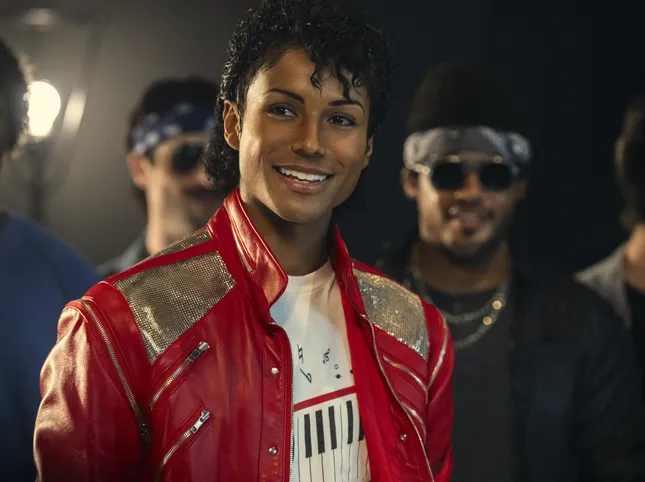
“Michael”: Who Really Sings in the Michael Jackson Movie?
If you went to the cinema to see “Michael”, you will surely have wondered whether the voice heard in the singing scenes of the film is that of the real Michael Jackson or of Jaafar Jackson, his nephew, chosen to play the King of Pop in the biopic which has already grossed $278 million worldwide (i.e. 236 million euros). The answer is less clear-cut than expected. In the sense that the film, as told by music supervisor John Warhurst in several interviews, he does not rely on a single source, but builds a complex hybrid between archive material and live interpretation.
The sound basis of the performances: the archives
The sound basis of the performances shown in the film – for which the soundtrack has also been released – derives largely from the archives officials made available by the Michael Jackson Estate: original multitracks, studio recordings and historical materials that allowed those who worked on the audio of “Michael” to isolate the voice of the King of Pop and to rework it, in one way or another, in a cinematic way. Me original multitracks, for those who are wondering, are the separate recordings of the voice and instruments, used in the studio when the songs were created. This material allows the sound engineers to isolate Michael’s voice in an extremely clean way, without the complete musical base, and to reinsert it in a new sound context: it is precisely this operation that gives viewers the sensation of a “closer”, more intense and more present voice compared to the known record versions. Added to this, in some cases, live recordings from real performances or television specials, remastered and adapted to the scene. The result is a voice that retains the authenticity of the original recordings but is “reconstructed” to function in the language of cinema.
The case of the performance for the Motown special
An emblematic case is the reconstruction of the famous performance of “Billie Jean” presented during the special “Motown 25: Yesterday, Today, Forever“. On that occasion Michael’s voice was actually performed live, while the backing track was pre-recorded. In the film, this structure is maintained but reworked: the original 1983 vocal is recovered from the archives and isolated, while the instrumental part is often remixed or reconstructed to adapt to the visual and rhythmic language of cinema. Added to this are small synchronization interventions with the performance of actor Jaafar Jackson, which help to make the final result coherent with the action on the screen.
The case of “Beat it” and Van Halen’s guitar
In the case of “Beat it”, however, the voice and the backing track derive almost entirely from the original 1982 master tapes and the related multitracks. Even iconic elements such as the famous guitar solo by Eddie Van Halen remain unchanged compared to the historical record. What changes is the way the sound is treated: compression, reverb and the addition of ambience help transform a studio recording into an experience more similar to a live performance.
The performances of the actors on the set
Alongside this archival work, however, the film also introduces a fundamental component, which we have anticipated in some way: the vocal performances of the actors on the set. «But does Jaafar Jackson really sing?», many have asked themselves in recent weeks. The answer is: yes, Jaafar Jackson really sings. It does, however, only when recreating some recording sessions: this is the case, for example, of the scene linked to the genesis of “Don’t stop ’til you get enoughThe same happens with the actor who plays Michael as a child, Juliano Valdiin the sequences of “I want you back“. In these moments, the music is not only reproduced, but is actually performed on the set. Jaafar’s voice, in several sequences of the film, was then partly merged with the original one of Michael Jackson, creating a hybrid effect between interpretation and archive. In other moments, however, especially in the more intimate scenes set in the studio, it is only the 29-year-old’s voice that is the protagonist. “During the performances I sang live into the microphone over Michael’s track. It is a combination of my voice and his”, Jaafar said. This approach is not accidental, but reflects a precise creative choice by the production. Music supervisor John Warhurst explained that, in some scenes set in the studio, the actors sing completely live. without overlaps: «We talked a lot about whether to actually record them in the studio, and the answer was yes. They were able to do it. It all depends on the philosophy of the film: do you want the audience to feel the real Michael within the story or a total reinterpretation?”.
The final result
The final result is therefore a stratified vocal systemin which three distinct levels coexist: Michael’s original voice from the archives, the live performance of the actors on set and the fusion between the two through sound editing. It is precisely this overlap that generates that feeling of authenticity that many spectators perceive in musical scenes, where the boundary between past and present becomes deliberately indistinct.