Brian Eno: art to stop the cruelty of the world
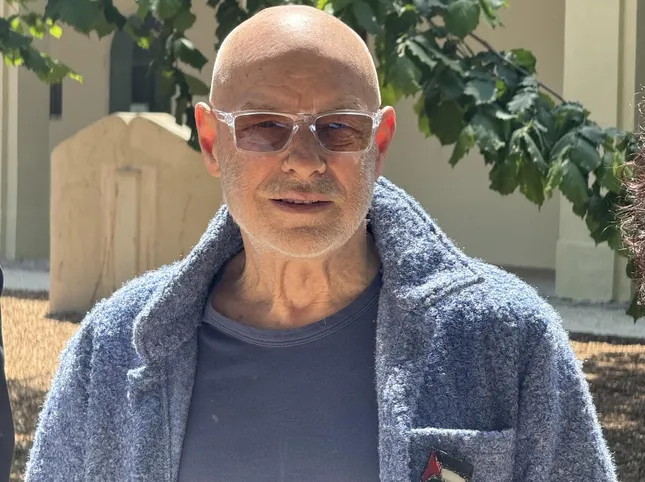
“We are overwhelmed by messages and music. I just want to offer a space where we can be with ourselves”, says Brian Eno, entering the Gardens of San Paolo in Parma.
Eno was in Parma for the inauguration of “SEED” and “My Light Years”, two projects open from 1 May to 2 August: on the one hand a site-specific sound installation designed for the city’s green oasis together with the Turkish journalist and writer Ece Temelkuran, on the other an exhibition dedicated to Eno’s work on light as an artistic medium: at the Ospedale Vecchio, a 1400s building recovered after a long time, there are historical works such as “77 Million Paintings” together with unpublished works and new creations, such as five new Light Boxes. An example of functional art “not as an end in itself but to enhance the places”, according to the city mayor Michele Guerra.
Politics and thought
Eno shows up with the Palestinian flag pinned on his lapel and immediately links the meaning of the project to the present, because everything we do is political, he explains. “One of the things we have stopped being aware of is that we live in an absolute flood of messages telling us what we should think about, how we should think about it, how much we should think about it, what we should overlook and so on.” For this reason, he explains, the artist’s task today can be different: “You know what? You can think what you want. You can think about this bird. You can think about how you feel sitting on this bench. Wouldn’t it be nice to live like this, in this kind of situation, instead of living in a world where 25 trillion dollars are spent on weapons every year?”
Ece Temelkuran echoes him: “I think this garden has a message: stop and think. Don’t go any further, stop and think. And what better way to say it than through the birds, which don’t really say anything. They are allowing you to think, to stop and think. And I think this is the garden to stop cruelty with our innate impulse to create beauty. So I hope the people of Parma can come here, stop and think.”
The meaning of “SEED” is right here. “There are already too many messages. I don’t want to give messages. I would just like to offer you some space with yourselves.” The installation, created with Temelkuran, is conceived as a place of quiet within the noise of the present. At the end of the experience, the sound collected in the park will be recorded on a single vinyl edited by Eno himself and destined for the Casa del Suono in Parma.
Artificial intelligence?
There is also time for some considerations on the role of artificial intelligence technology, for an artist who has always used software to generate art and music: “77 Million Paintings”, his most famous work, owes its title to the almost infinite combinations that are slowly generated on the screens, and which would take a year to be seen in full. The exhibition “My Light Years” itself is designed, together with the curator Alessandro Albertini, as a space where you can sit and watch the works change shape and colour, on one of the many sofas. A different approach from that of artificial intelligence as we understand it now.
“A system is not what it is described as. A system is what it does. What concerns me now is not the AI itself, because in reality we have been using versions of AI for many years. It is the re-engineering of AI for political purposes, as yet another system of control, and as yet another way to make a few already rich people even richer.”
Music yesterday and today
Among his most beautiful works is his “turntable”, a continuously changing turntable, which U2 took as a model for the stage of their show at the Sphere in Las Vegas. Eno tries to explain how his and our relationship with music has changed: “Every era has a form which is the canon, at the center of discussions: in the sixties and seventies it was music, now it is no longer. There is too much music for everyone to share the same things. At a certain point, everyone knew what everyone else was listening to. We no longer know.” For Eno this does not mean loss of absolute centrality, but transformation: “It has a different role in the ecology of culture”.
But, he is keen to point out, “Don’t call me a pessimist. I find there is more interesting music out there today than ever before. There is so much to listen to.” And he jokes about the idealized Sixties: “Whoever says it used to be better forgets that there was a lot of rubbish in the Sixties. If you take the Top 20 of 1966, 17 of those songs you would never want to hear again in your life.”
According to Eno, however, the current chaos could produce a new shared order: “In the next 10 or 20 years there will be a new agreement on music that we haven’t seen in the last 25 years or so. There will be another canon.” Then he states with irony: “When I say soon, I don’t mean during my lifetime”.
“SEED” and “My Light Years” are created by the Municipality of Parma with the curatorship of Alessandro Albertini (Influxus) in collaboration with Dominic Norman-Taylor, Juliana Consigli and Martin Harrison (Lumen London). “My Light Years” is supported by the Cariparma Foundation and the Davines Group, while “SEED” is supported by the PAC2025 – Plan for Contemporary Art, promoted by the General Directorate of Contemporary Creativity of the Ministry of Culture. Both can be visited from 1 May to 2 August, respectively at the Ospedale Vecchio and the Monumental Complex of San Paolo.