Madame: “The disenchantment to free oneself from lies has a price”
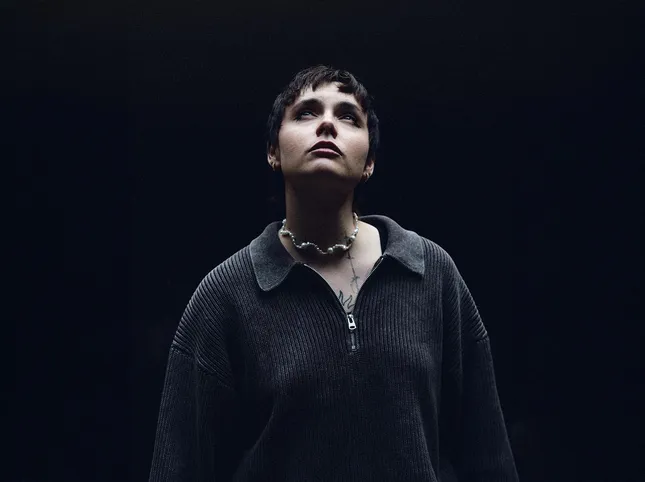
Madame has “eyes full of disenchantment”. Sometimes he lowers them, as if to protect himself. Others he raises them and stares at you, and there is only fire in there. His third album “Disincanto”, out on April 17, produced by Bias, is exactly all this: love, anger, prayers, violent blows to the industry, intimate truths about his family and his mental health, open wounds, joy of living and gratitude. After three years she returns like this: freer, more exposed, more alive. And at 24, he doesn’t keep that disenchantment to himself, but wants to pass it off as if it were a virus: it’s the moment in which one frees oneself from some preconceptions and mental constructions, abandoning the idea of following a pre-established model. But there is always a price to pay. Just like what he wanted to provocatively put on the album, which he will present live with a long summer tour.
In “Madame” in 2021, with the piece “Instinct”, you began like this: “Sometimes I think: why is it only me? Only me? I stare at the antechamber of the skull and get pissed off. And I say: why only me?”. In “Disenchantment” of 2026, five years later, you turn everything upside down: “I no longer live with instructions underneath. I hope everything I know abandons me.” Can you tell me about this Madame “with her eyes swollen with disenchantment”?
In “Istinto”, the opening track of the first album, there were banks of fog before my eyes. There was naivety and enchantment. The fog was also due to the lack of experience. Things happened to me and I didn’t know why. Even now it is like this, but today I have many more tools to decipher them, here is the “disenchantment”. One of these is writing, it’s writing them. Maturation came thanks to these tools. Let me be clear: the fog has not gone away and perhaps it will never go away, this is because there are still so many questions inside me….
And many questions, consequently, are also on the album.
Today, perhaps, compared to the past, I ask myself more correct questions, even if the answers are relative and ephemeral. This is an album full of questions and doubts. I think I have become more courageous: before my courage was more instinctive, today it is more mature and sought after, desired.
Speaking of “Dubbi”: in “Volevounderre” you are joined by Marracash. To the question “who are we without love, without status, without money?” can it really be answered?
This is also disenchantment: there are not always answers. Or rather, I even gave myself the answer, but it is extremely cynical and negative. “Who are we without love, without status, without money?”: the answer is “nothing”. But it’s an answer I don’t want to give in my music, because I don’t know if it’s entirely true. Marra, in the piece, gave me his answer in which he seems to have understood something more. But will it be true? (smiles, ed.).
In short: a matryoshka of doubts.
My life is a matryoshka of doubts. And I’m happy that it is like this.
That you don’t want to give in to offering cynical answers is clear when at a certain point in the album you repeat from your gut: “Madame isn’t just entertainment”.
I’m a killer of other people’s free time because I “force” you to think a bit with my songs, so I keep your free time, actually, occupied. No, it’s not just entertainment. For me, music is something intimate, I almost find more modesty in playing a song to the person to whom it is dedicated than in stripping myself. Something so existential can’t just be entertainment. Then it is clear that what I do is covered in entertainment. There is a casing with some substance inside, so I like to hide the substance in there. Which says it like this…(laughs, ed.).
You also target the music industry: you do it in “How are you?” and especially in “Never Again”. The first bars of the latter evidently refer to a specific person (to Shablo, with whom Madame had begun a collaboration for the creation of “Love”, ed.), then you broaden the lens and talk about various demeaning dynamics. You call it “the horror factory”. Why are you so angry?
Because I suffer like hell from injustices and lies. The biggest wrong that they can do to me and that I can do to myself is: lying to myself. There is anger, it’s true, there is also radicality. If something is wrong you can’t turn away, only the slothful do it. I have nothing to lose: I want people to know how it works in music because I don’t believe that certain dynamics only happen in this sector. And if someone, after listening to one of my pieces, feels like rebelling in their own environment, I can only be proud of it.
So can music change what we have around us?
When I wrote “17”, several years ago, I will always remember the message from a lady: “I quit”. Her job disgusted her, she felt oppressed. Listening to a little girl rapping “Do whatever the fuck you want, lady”, she made a very difficult choice, perhaps even counterproductive for a 63-year-old woman. But that song had moved her. This is why “Madame is not just entertainment”.
You also point the finger at yourself. You sing: “I pretended to be someone else too” and in “Red as blood” you talk about a kind of guilt for having achieved success.
The first person you need to report is yourself, it’s too easy to just blame others. I also know that I have had limits: when you are prey to wickedness, even due to inexperience, in reality you too have made it happen, so it is necessary to examine your conscience.
Do you have any regrets? If you went back, wouldn’t you do some things again in terms of music or artistic choices?
I’m not interested in changing the past. The shit that you step on once comes back, you have to be good at avoiding it and not stepping on it again. For me, life has elements of cyclicality.
The communication campaign for this album was explicit: you wanted a barcode on the record because “everything has a price”, furthermore posters were hung with questions and photos, among these there is one of a hospital bed where you were hospitalized for OCD (obsessive-compulsive disorder, ed.) which you talk about in the song “Thank you”. Does exposing yourself like this have a price to pay?
I am not interested. It has never hurt me to tell the truth and this is not only my way of writing, but also of living. This is the album of “disenchantment”, everything screams that I have to be sincere, even on that topic. Yes, everything has a price, it’s true, every action has a consequence and generates something in others, but at the moment I don’t know what else to say… it will be interesting to see people’s reactions to the release of the album… I think that many of those photos, including the one you mention, are clearer when listening to the album.
I’ll stay on topic, trying not to be inappropriate: in “How are you?” you actually say “In two years I haven’t given birth for a while, you know, I was in a shelter for weeks”. How important was it, despite the world constantly telling us to run, to accept that stop?
I was still doing the “L’amore” tour, I went to Filippo Sugar’s office and told him: “I’ll give you the next album in three years”. He said: “But come on, do it first, you’ll see”. It went as I said, I’m a bit of a witch (smiles, ed.). If everything screams that you need to stop…and you don’t, you’re an asshole. I would go to the studio and get the outlet, I couldn’t make new music and I accepted it. It was immediately difficult, because music is really part of me, it’s part of my biology, when I write it’s one of the few moments in which my rationality and my emotionality dialogue. Depriving myself of that was like detaching a part of me, but I had to do it….
Was working with Bias, the producer who oversaw the entire project, a turning point?
We have known each other for many years, we were born and raised together. At a certain point everyone followed their own path and then we met again in the same moment of maturation, him with the sound and me with my pen. Now we are also neighbors.
Bias (he is sitting next to Madame, ed.) what can you say about the sound?
There is homogeneity because we have found a special balance between us. We worked in symbiosis looking for something of our own and personal, something that distinguished us.
Francesca (Madame, ed.) do you want to add something?
We delivered the complete album, we wanted the product to be evaluated as a whole, not in pieces, not “individually”. We didn’t know how it would be perceived. We had no external feedback other than that of insiders. It was alienating, at times it’s as if we were working in a bubble.
This is also a record full of love: I think of “Don’t betray me”, to “No pressure”, to “The Worst Person in the World” and even to “Swiss whore” with that “I want to see you more confident”.
Already in the album “L’amore” there was great sincerity on the theme and even something more. The only disenchantment that I haven’t been able to achieve is perhaps that regarding love. “Don’t betray me” is a prayer, a request to the limit, it is the last wish before dying. “No pressure” is the most enchanting piece on the album, it is a continuous illusion, it is full of dreams. “The worst person in the world” is also a fantasy: at the center there is a love story that knocked me down, but which I turn around in the song. And I basically say to the person who hurt me: at the risk of being “the worst person in the world, this time you will be the one to succumb”.
“Swiss whore”?
It’s dedicated to my average die-hard fan. I have met many fragile girls, that “I want to see you safer” sung in the middle of a slightly crazy piece is for them. I was like that too, I was the least of the shits, I went around with the trolley, but luck changes. The piece is for those girls who are waiting for their luck to turn.
In addition to Nerissima Serpe and Papa V, in this piece you also wanted Goccia, a raw emerging rapper. You offered him an unexpected opportunity. Why?
Bias introduced me to him. It struck me, it’s raw, original, true. I hope he never loses his brutal being, his sincere being.
“Ok” talks about the annulment of individual will, but there is a bar that struck me, at Fabri Fibra, because it puts its finger in the folds of the family: “Sixty-eight weeks that I haven’t spoken to my father and I feel less bad, yes, brother, I think: ‘Thank goodness’”. Is cutting the umbilical cord part of the disenchantment?
It’s the first disenchantment which must be carried forward. Breaking away from the “instructions” offered by family and relatives is essential. My loneliness also comes from a detachment from these roots, probably. But…well, thank goodness…Parents always see you the same way, they have an idea and don’t change it. Maybe I never liked the way they always saw me. I want to build my own identity.
In “Thank you” you stand in front of a psychologist and say: “Compared to the world my life is extraordinary”. It is a phrase pronounced in an almost moving way. Can you tell me from your point of view?
As I write the songs, awareness comes to me. Writing this piece in which I list injuries and problems, I got to the end and said: “Well, it could have been worse.” This too is disenchantment. Pain is often used as an excuse, it is an alibi for not taking responsibility. Disenchanting yourself with your pain is important. We need to take courage, we need to move forward, not give in. “Compared to the world my life is extraordinary” is a phrase that gives me courage.
This is a record of light?
Absolutely yes, despite the tale of shadows. I hope that those who listen to him find their own disenchantment and free themselves.