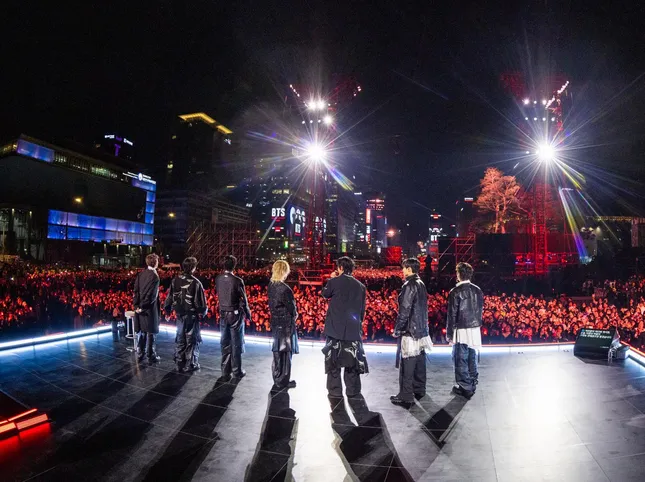
Behind the scenes of BTS’ comeback
For being one piece of a monumental strategy to relaunch the hype of a band with an enormous global following, “BTS: The Return” – starting tomorrow on Netflix – is truly a strange documentary, whose limitations and merits all lie in the unique conditions in which it was made.
It is evident as the director Bao Nguyen had access to the spaces where the band ate, conversed and worked on the tracks of the new album in well-defined moments of the rapid gestation of “Arirang”, as well as the other professional figures that we see gravitating in the daily life of the group. Much of the ninety-one minutes of footage edited into the documentary tells the story the golden Los Angeles isolation of the seven members of the band, found themselves together for the first time after the years of compulsory military service and the solo commitments of some members of the project. Locked in a splendid villa overlooking the Los Angeles valley and its skyscrapers, the seven Korean boys do find themselves in a disorientating, alienating situation, which as they well point out no Korean boy band has ever lived.
In fact, no group has remained on the scene at their levels of popularity for twelve years, becoming a point of reference for an international audience so numerous as to undermine their home fans in terms of numbers and relevance. No group has ever survived the twenty months of press silence imposed upon military conscription. “BTS: The Return” wants to be the story of the excited months in which BTS tried to keep faith with the promise made to their fans to return as soon as possible and without disappointing them.
K-Pop stars in limbo
So the seven boys, no longer so boys, find themselves in the US compound, busy to re-establish relationships with those who are work colleagues but also peers with whom they have lived for much of the last decade, only to then lose contact during the lever. There is a particularly significant passage, which is meant to be a celebration of the group, but happens suddenly BTS appear incredibly older and wiser than their early thirties. The band revisits their first public appearance together in which they are badly made up, dressed less carefully, very young and still very “set”. The cut to the faces and adult attitudes they have in “BTS: The Return” as they look at their early selves is perhaps the strongest image of the documentary. Once confident and yet unaware of their position in the world of Korean music today the stars appear undecided on how to define themselves. Are they still just plain Korean boys, as they like to tell each other (even if what little of their lives we see tells a different story), or are they now grown men, drinking soju together with every meal, building muscle at the gym while homesick in Korea? The answer for “BTS: The Return” seems to be: both.
It is not clear how consciously, “BTS: The Return” photographs this personal and artistic disorientation of the group particularly well. The two years of military service were an abrupt interruption that now forces them to return, as quickly as possible and with the best songs they can put together in the scant year they have given themselves to find their new artistic direction. At a certain point they ask themselves this question what the theme of the album is, what story they try to tell. In the old lyrics and in the hits immediately preceding the hiatus they no longer fully recognize themselves, they would like to express a more adult sound and content. At the same time they don’t know exactly who they are at this point in their lives or what story to tell, why as soon as the uniform was discarded they were taken to Los Angeles, locked in the super villa where they are staying and catapulted into a race against time to put together fourteen tracks for the new album and find the launch single among them.
The unexpectedly sincere behind the scenes of K-Pop
Perhaps what makes “BTS: The Return” so special is the Korean approach to telling the story of its own pop music: the motivational phrases, contents designed specifically to excite the fans but also behind the scenes that reflect the very construction of K-Pop, in which the seven singers and dancers are at the same time involved and guided, in a creative and managerial process with disconcerting turns. We move on to a sequence in which a band member tries to write the lyrics to a song in English about how he feels stuck in the situation he finds himself in and unable to react to the meeting in which the concept of the album that the guys have been looking for for days is presented, proposed, lowered from above? by a collaborator. The manager explains to them and to us the history behind the concept of “Arirang”, telling the story of the emigration of a group of young Koreans to the United States which led to the first recording of a Korean folk song in America. A parallel shot of meaning, a perfect metaphor for the results already achieved by BTS at an international level, the result of who knows how many meetings and research by their working group, which we obviously see to a minimal extent. Work which, however, can be understood by looking at the posters welcoming the group to the meeting, on which someone has pasted all the musical, visual, cultural references that the album will look at: there’s Charli XCX’s “Brat” and a couple of EPs from Korea’s domestic competition, but also photos and artists from the ’80s and ’90s. It’s sort of like a huge Pinterest dashboard that someone distilled into for the group everything relevant that happened in the music world while they were in the army and everything to look forward to producing “Arirang” in record time.
If the final part of the documentary, when we return to Korea and the “crisis” generated by the lack of direction is resolved with a successful meeting with the big boss of the record company, it is The most interesting part of “BTS: The Return” lies in afternoons full of melancholy and unsuccessful American meetings. A documentary from which it also emerges how to unleash a certain underground tension the growing weight of the international public in the group’s musical choices. In fact, in “Arirang” there is a sampling of a traditional Korean song which is discussed at several points in the documentary, as well as the balance between English and Korean lyrics of the songs. The management repeatedly suggests to the band that they can no longer only look at the home audience, while some of the group members find the long folkloristic insert (designed to attract and amaze foreign audiences) an almost patriotic, nationalistic note, which they would like to tone down, keeping it only for the dance breaks during live performances.
“BTS: The Return” in short it is a documentary that thrives on opposing and often opposing forces, fluctuating in pace, tone and emotions. It alternates blatantly celebratory moments with moments of very melancholic truth about the strange moment in which a boy band, Korean or otherwise, finds itself confronted with the evidence that its members are now adult men. A moment in which finding a way to be together and make worry-free but somehow sincere pop music becomes more complex, perhaps impossible.