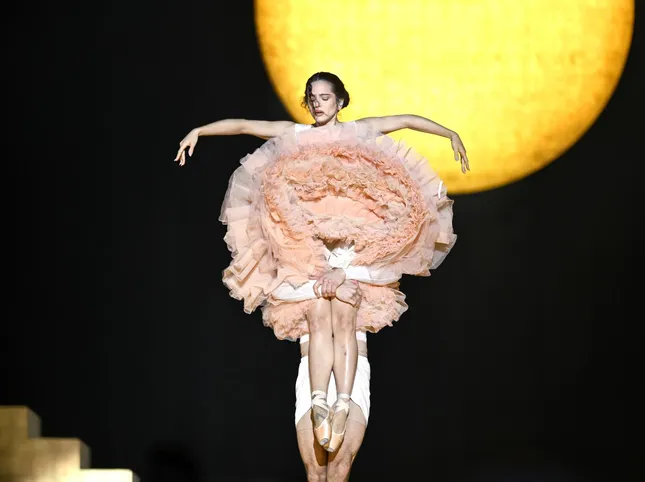
Rosalìa is ill and cancels the concert at the Forum: the story
On the date at the Milan Forum of his “Lux tour”, in front of almost 12,000 people, Rosalía was forced to stop. From the beginning something was wrong: the concert started 45 minutes latebetween one song and another there were longer pauses than usual, the rhythm was brokenas if the body couldn’t keep up with the perfect machine on the show. But Rosalía tried. He tried to carry on the live show, to stay within that dimension, to still give something to a packed Forum, completely on his side. Then, at the end of the second act, it really stopped. He spoke to the public, without construction: he said he felt ill, that he had vomited, that he had food poisoning. And he made the most difficult decision, the one that no artist wants to make on a stage like this: canceling the concert. Not because he didn’t want to continue, but because, in his condition, he couldn’t have given his all. And for her, evidently, being on that stage without being able to give it made no sense.
It remains to be seen whether refunds will be granted or notgiven that the Spanish singer-songwriter still performed for an hour. There are dozens of enthusiastic reviews about Rosalía’s latest tour. And it’s difficult to contradict them: the yield of what we could see up until the suspension was magnificent, the ambition out of scale. What was on stage was, to all intents and purposes, a work of art. A show, divided into acts, hybrid, stratified, which holds together opera, ballet, performance art and contemporary pop, constantly suspended between spirituality and flesh, between liturgy and rave. But precisely in this continuous tension, in its desire to always be something more, one of its limits also manifested itself: an excess of citations and superstructures which at times seemed to obscure what makes music true and spontaneous.
The entrance is already a declaration of intent. Rosalía arrives in the spotlight inside a case, like a “Reliquía” precisely, on a wooden stage that recalls more a museum or a theater than a pop arena. Behind him two staircases, in front, in the center of the building, an orchestra: the first part of the show is entirely built on dialogue with the musicians, on an almost sacred dimension. Songs like “Divinize”among the most beautiful pieces of his latest project, “My Christ cries diamonds”sung in Italian as a veiled Madonna, or “Berghain” with its crazy and electronic final coda, highlights the complexity, at times forced, of “Lux”a record that mixes different languages, registers and languages. The texts, translated into Italian, flow above the stage, which is more basic than the concert setup, and seem like captions for an installation. Each piece is almost thought of as an independent painting, a room in a museum rather than a stage of a live performance, and this breaks up the emotional flowundoubtedly also hindered by his precarious health conditions.
At the center of everything, of course, is her. Rosalía sings flawlesslysometimes she moves on pointe with a classic grace, other times with an overflowing and threatening energy on the notes of “Saoko” or “La Combi Versace”accompanied by a changing dance troupe, within which also stands out Giulia Stabilewhich follows and reflects her transformations, from saint to provocateur in hold-ups. Some passages, just like some songs on “Lux”, appear more ostentation of skill and abundance than real necessity. Rosalía stays a total pop starcapable of imagining and creating something that goes far beyond the concert format. But in continually wanting to prove that he is, he ends up overloading his own vision. The result, from what we could see for an hour, is one extraordinary and hypnotic show. And at the same time deliberately and stubbornly “too much”in the language he uses and in everything he wants to keep together. We hope to see you again soon a complete date.