
Butthole Surfers, an unrepeatable anomaly in rock
More than a warning, the initial disclaimer reads like a summary of the story about to be told. “This film contains content that some viewers may find disturbing: including strobe lights, drug use, nudity, puppet nudity, puppet violence, exploding toys, underwater filming, loud music, and regret. We recommend viewing to an aware public”. The attention focuses above all on the word “regret”, “regret”, while in the background we hear the intro of “Sweat loafFlea from the Red Hot Chili Peppers immediately thinks of offering the main key to everything: “I Butthole Surfers they are something that could have been born only at that precise moment and in that place“, he says. Thus opens “Butthole Surfers: The Hole Truth and Nothing Butt”, the documentary directed by Tom Stern. After making its world premiere last year at the SXSW Film & TV Festival in Austin, Texas, the feature film was presented for the first time in Italy last March 5th at Seeyousound International Music Film Festival in Turin.
The film proceeds as a journey into a crazy archive of American counterculture. Tom Stern worked for a long time on the project, choosing an apparently classic structure, which chronologically follows the birth and evolution of the band, but continually puts it into crisis with a nervous and layered editing that alternates contemporary interviews, archive footage, amateur recordings, animations and surreal reconstructions. The result is a a story that seems to reflect the same anarchic logic of the Butthole Surfersin which memory is not organized in an orderly way but re-emerges as a chaotic flow of episodes, images and confessions.
The most traditional part is entrusted to interviewswhich bring together almost all the protagonists of the band’s history. Grown-ups appear in front of the camera Gibby Haynes, Paul Leary (who claims to have managed to become “normal” over time), King Coffey and bassist Jeff Pinkus, along with other musicians who have orbited the group over the years. The drummer is inevitable Teresa Nervosawho passed away in 2023, to which his presence becomes a sort of homage. Stern, however, chooses to limit the interventions to those who have truly shared a phase of their trajectory, leaving that each period is told by those who experienced it first hand. In this way the documentary also shows the unstable nature of the band, famous for the continuous rotation of bass players and for an identity that has always been redefined along the way.
Alongside these testimonies, the film inserts external voices that help to measure the impact of the Butthole Surfers on the rock scene. Flea of the RHCP, Henry Rollins of Black Flag, Thurston Moore by Sonic Youth, Dave Grohlthe producer and voice of Shellac Steve Albini – who passed away in 2024 – and other musicians talk about how much that sonic and performative chaos influenced the imagination of American alternative music, up to and including groups like Nirvana, who shared the stage with them several times in the early Nineties. Their words do not build a celebration, but rather the portrait of an anomalous and unrepeatable presence in the history of rock.
From a formal point of view, Stern deliberately avoids the nostalgic veneer of the classic rockumentary. The archive images are often dirty, shaky, recorded on VHS or recovered from amateur materials, and are edited together with animated sequences and reconstructions made with puppets and marionettes. These visual interludes, which recall both the aesthetics of underground television programs and that of the most deformed comics, serve to recount episodes of which no images exist or to transform the memories of the protagonists into small grotesque scenes. The tone oscillating between irony and absurdity allows the film to also go through darker moments without turning into a heavy news story of excesses.
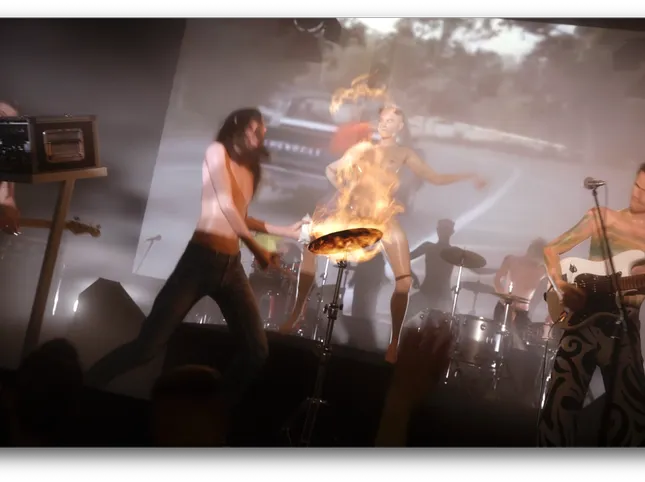
The story that emerges is that of a band born in the early 1980s in Texas from the meeting between two university students apparently destined for an ordinary future. Gibby Haynes and Paul Leary discover punk, conceptual art and a form of creativity that rejects any gender discipline. Butthole Surfers become like this something more than a rock band. Their concerts are disturbing performances in which noise sounds, video projections, nudity, provocations and a black humor that seems to want to sabotage the public’s every expectation coexist. In the documentary these years are reconstructed as a long journey into the American independent scenebetween broken-down vans, improvised motels and an existence constantly lived on the margins.
As time passes, the story moves towards the nineties and towards the improbable encounter between that anarchy underground and industry musical. The unexpected success of “Pepper“, from the album “Electriclarryland”, which in 1996 reached the top of the “Billboard Modern Rock Tracks” chart and at position 29 on the “BillboardHot 100 Airplay”, brings the band into a system that does not seem made to contain them. The film does not try to simplify this passage and it also shows the most difficult consequences of that seasonbetween addictions, internal tensions, lost friendships and the dispersion of the group after the last studio album “WeirdRevolution” of 2001.
In the end, what remains is not just the chronicle of a musical career, but the portrait of a community of outsiders who transformed rock into a form of total expression. Stern avoids any form of hagiography and lets the more human side of the protagonists emerge, today very far from the image of noisy anarchists that made them famous. The documentary suggests that the Butthole Surfers’ legacy is measured not so much in records or chart hits, but in the radical idea that music can be a gesture of absolute freedoma creative short circuit born in a place and at a time that is unlikely to be repeated.
