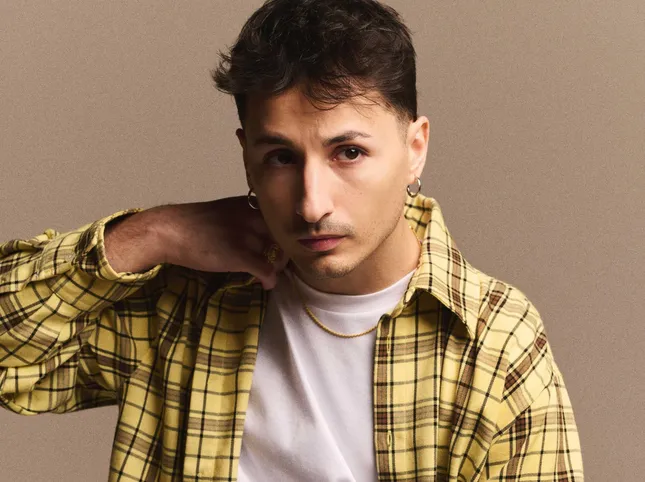
nayt didn’t “sanremize” himself
There are rappers, and in general many names who land at the Sanremo Festival, who, like gremlins, transform and change their appearance to stay on that stage. Then there is nayt that on a precise identity, instead, he is establishing a career. The fact remains that seeing him in the spotlight at the Ariston, where he will present “Prima che”, immersed daily in the circus of Italian song, could be unsettling for some. “I’m very calm: I know the piece I’m playing and I know what album will come next,” replies William Mezzanotte, this is his real name, who will release the new album “Iindividual” on March 20th.
How did the rehearsals with the orchestra go?
Better than I imagined. I had already done some on my own and I thought that I would then have to work a lot with the orchestra but that wasn’t the case, I felt good, everything went well. In all these years I’ve played in some slightly absurd places, so I’m prepared. Now I’m trying to get the hang of movements and physicality, which are other fundamental aspects for me.
Why is this the right time for the Sanremo Festival?
It’s not a question of “moment”, I simply wrote what is the right piece for me. It came naturally. It came out in one afternoon, I could hear it strong, even on the beat. At a certain point they said to me: “why don’t we try to propose something in Sanremo?”. And I thought this could be the ideal song.
For you, more than for Sanremo.
Well, yes, it’s actually not a song with an opening chorus. I have always aimed for it, but it was not a given, precisely because of its structure, that it would be taken and accepted. I think it’s a rap piece like it’s never been brought to Sanremo before.
You haven’t “sanremized” yourself…
Look, I’ve always thought: if one day I go to Sanremo, I will do it with a piece that doesn’t distort me. When this isn’t the case it’s a problem. If I didn’t do it this way, if I didn’t go to Sanremo with one of my songs, everything I’ve built, with effort and work, over all these years would collapse. Everyone talks about Sanremo as if it were decisive, for me it’s a brick to add: I have a new album, I’ll do a new tour. I look at myself projected forward.
At the Milan Forum, almost foreseeing this moment, you said: “Everything I do, I do for music”. Do you think some of your fans may not have understood this participation in the Festival?
When I announced my participation, I noticed that there was a part of the public, not a preponderant, not a majority, who was mostly scared. They are afraid that I might lose my character at Ariston. I made that speech you mentioned, at the Forum, because I was already noticing this climate: some fans, simply, seeing me in a location like a sports hall, wondered about this “openness” of mine. In fact, the arenas give the perception of an artist more “for everyone”, not a niche one. And now some will think: “he goes to Sanremo, there is the risk that he will indulge that world”.
But does it really make sense to think so?
Yes, because when some artists fit into some mainstream dynamics, transformations happen, and I therefore understand a listener’s point of view. But at the same time I’m very calm: I know the piece I’m bringing and I know what record will come next. I am centered and confident in what I am doing.
What questions does the song “Prima che” pose and how does it fit into the broader plan of the album “Ioindividual”?
It’s a manifesto song for the album that’s coming. AND as if I had a concept that unites all the records I make, the work of art is this, it is life itself if the artist is at the service of the art he makes. There is a common thread that unites everything. This album specifically always talks about the search for identity, but in particular about contact with others, about the search for others. The central question is: how do we stay together? “Before” focuses on a detail of this topic, which is recognition. It’s as if I were launching a hypothesis: perhaps to be together we have to recognize each other, perhaps we have to really see each other for who we are and this isn’t happening.
You say “before the first woman”, so you are also talking about an ancestral recognition, which starts before the birth of the single individual.
The “first woman” is the mother. Yes, the piece broadens the lens, it talks about society, it asks where we come from. In the album the origins are treated from various angles.
Coming together in a time of fragmentation was also a key point in Bad Bunny’s Super Bowl show.
It is a central theme, today more than ever. I think that great artists have the ability to anticipate the topics that we will all go on to talk about. Today, we have it before our eyes, we cannot understand ourselves. And this is also tainted by the social filter that we often use mostly to communicate. Social media has intrinsic dynamics that don’t work: one posts, then waits for feedback from others and so on, like in a role-playing game. But it’s not a real exchange. Certain moral and political themes need an instantaneous debate, which changes during the dialogue itself, not a question-and-response in turns. And in my opinion we are metabolizing this.
How are you working with Zef, producer of the Sanremo song?
For me Zef is a great producer, I met him last year. We saw each other relatively few times, but on those occasions many pieces were born. He produced part of the album and this is the first time I’ve opened up and collaborated with multiple producers for a project. I’m with him because he has taste. I don’t need much… I need a basis for writing, and when it comes, I write a lot.
This idea of connection therefore also reverberates in the music, it is not just a “theme”: it is a modus operandi.
It’s like this, in the songs I talk about relationships with others and at the same time I, who have always had difficulty feeling part of a community, am fueling this tendency to involve more people in my journey. And I want to encourage this path because I believe that at this stage it is necessary.
In Sanremo, during the evening dedicated to covers, you will perform together with Joan Thiele with the song “La canzone dell’amore perdu” by De André. Why this choice?
I chose it because, by bringing a very rap piece, I also wanted to express my more singer-songwriter side on the covers evening. I wanted a piece that resonated with my vocal and emotional chords. Joan is special, she helps me explore and communicate with the feminine. The piece talks about a finished love, about new loves. It will be nice because we will treat the text as if we were mirroring it. Things always happen in two, for better or for worse. And we will represent the song honestly.