
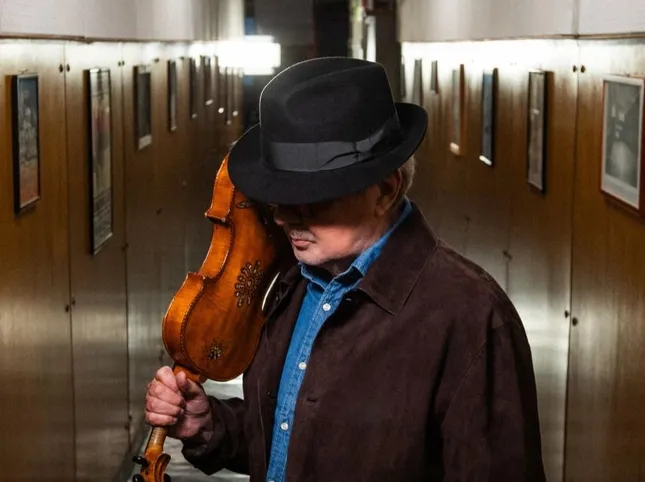
Mauro Pagani, “a handsome gentleman of a certain age”
The phrase is pronounced, in the documentary “Andando dove non so. Una vita da fugasco” directed by Cristiana Mainardi, by Mauro Pagani, and refers to a piano that is in his recording studio, the Officine Meccaniche. But it is also an adequate description of the protagonist of the work, musician, producer, arranger, author of soundtracks, who turned 80 a few days ago (February 5). The documentary was presented in its national premiere, after some screenings reserved for the press, yesterday at the Teatro di Fiesole (Florence), in the presence of the artist and the director, and will arrive in Italian cinemas on 16, 17 and 18 February 2026 distributed by Fandango.
The subtitle, “A life as a fugitive”, is borrowed from the autobiography “Nine lives and ten blues”, published by Bompiani in September 2022 with the careful editing of Silvia Trabattoni. And the “fugitive” is the restless alter ego of Mauro Pagani, the one who has influenced his choices, decisions, turning points and changes in artistic and personal direction since his adolescence. The documentary tells them, with the voice of the protagonist and some witnesses, following a non-chronological track (thank goodness) but I would say almost sentimental.
Those who, like me, have known Mauro for a very long time (we have Brescian origins in common), certainly don’t need to be reminded of the many merits that Pagani has acquired in the field of music. Nor could the 97 minutes of duration of the documentary have been enough to host the testimonies of all those who have, in different ways, benefited from Pagani’s work or supported him over the years (Manuel Agnelli, Giuliano Sangiorgi, Marco Mengoni, Badara Seck, Mahmood, Dori Ghezzi, Ligabue, Arisa, Ornella Vanoni, and his life and work partner Silvia Posa participate, but the complete list would be much longer).
Compared to the somewhat worn formula of the classic documentary, in which there are people who talk “about” the protagonist, this has the advantage of featuring people who also talk “with” the protagonist, remembering and commenting on what they did together; and, despite a certain repetitiveness – so many hugs! – the mode works. There are also emotional moments (the one with Arisa, to name one), others perhaps less emotional and more “professional” (Manuel Agnelli), but overall everything is held together well. The result is not exactly a summary of Pagani’s career (as I said, at least three episodes would have been needed) but it is certainly a good compendium, as well as an affectionate portrait and a respectful tribute to a “handsome gentleman of a certain age” who left a strong mark in the history of Italian music.
