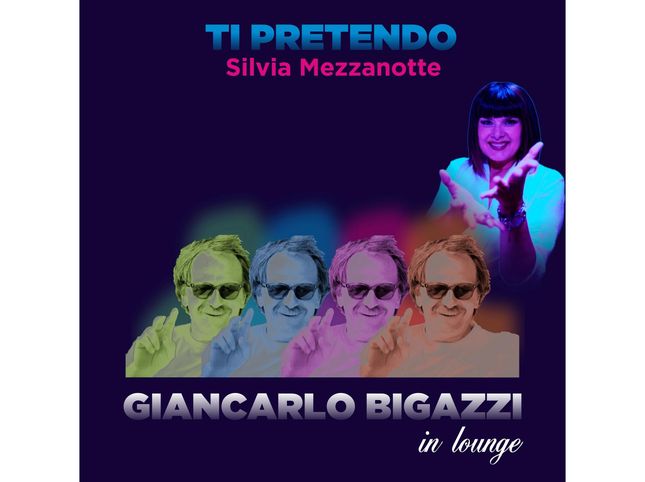
Giancarlo Bigazzi, “I demand you” in Lounge by Silvia Mezzanotte
Third episode of the series of rediscoperter in a lounge key of the repertoire of songs written by Giancarlo Bigazzi (more below the interview with his son Giovanni in which he explains the project): after “Self Control” and “A blow to the heart”, a version sung by Silvia Mezzanotte (formerly voice of the Matia Bazar) of “You pretend” came out.
The Hit of Raf taken from the album “What will remain of the 80s”, an absolute winner of the Festivalbar 1989 edition, has been rearranged by Papik and Peter De Girolamo, which we also find on the bass and on the acoustic plan. On the battery Luca Trolli, Simone “Federicuccio” Talone to percussion, Alfredo Bochicchio on guitar and Massimo Flicorno and trombone war.
“When I learned that Giovanni Bigazzi (creator of the project) was looking for me I immediately told me yes. The idea of being part of such a beautiful story, which celebrates in the lounge ‘the wonderful songs by Giancarlo Bigazzi conquered me immediately. I have a special memory of Giancarlo, because he came to greet us in the studio during the hot thrill recording, with the Matia Bazar.
Franco Fasano, the artistic director of the project proposed me I pretend to you, a song that belongs to my twenty years, and the circle has closed, because Raf is one of the songwriters that I love and listen more. The collaboration with Papik was also one of those dreams in the drawer waiting to be realized. In fact, he fully hit the mood I had in mind between seduction, class, elegance and charm … the things I want to represent with this song, today “.
Here is the interview a few months ago to Giovanni Bigazzi:
For just under a year now now Giancarlo Bigazzi’s repertoireone of the greatest authors on the Italian scene between the late sixties and the early 2000s, is the subject of an operation of rediscovery by GB Music, label and edition company led by the artist’s son, Giovanni: after the publication, last May, of a new version of “Self Control” (sung by Nicole Magolie and produced by Nerio Poggi – in Arte Papik – and by Peter De Girolamo) for the Forty years of the song brought to the success by Raf, in September last year, the reinterpretation of “A blow to the heart”, a song originally published in 1968 as side B of the single of Mina “Allegria” interpreted (both for the Italian and for the Spanish version) by Franco Simone, arrived. The project – completely in the making – has the common denominator the ambient / lounge sounds, and will culminate – when the accumulated material will be sufficient – with the publication of a celebratory vinyl that will collect all the covers made from scratch. With the aim, says Giovanni Bigazzi, “to make Giancarlo’s work, in the union of generations, known and rediscover from another point of listening, not only the younger ones but also among the listeners who grew up with his songs” …
Why “in lounge”?
The idea came to me by listening to a disc of Sarah Menesscal, where she revisits great classics of the Anglo-American tradition in lounge style. As a listener, even before as a producer, I always liked this type of arrangements and sounds, so it immediately seemed to me a great way to give a different reading key to my father’s works.
Can we think of the forty years of “self control” as the spark that kicked off the project?
In some ways yes. Once I had the idea, I had to look for a point from which to leave, and the forty years of “self control” represented the right opportunity.
After two releases, how is this project evolve today?
It is continuously becoming. When we have come out with a dozen covers, we will crown the work with the publication of a vinyl collection, entitled “Giancarlo Bigazzi in Lounge”.
Is there a time horizon for the end of work date?
At the moment no. Franco Fasano and I (artist, author and historical composer friend of the Bigazzi family, editor’s note) are laid the foundations of the third chapter of the series, and we are looking for an artist who wants to take part in the project …
Needless to ask what the next song will be published …
The fact is that it is not yet defined. We have options in mind, but it is still all to be decided …
How much does the interpreter on the choice of songs weighs?
It depends a lot on the vocal and expressive characteristics. We met with Franco Simone and we talked about it, because – obviously – the artist’s vision is fundamental, because it is to him that it is up to the song to give new voice. For “a blow to the heart” we found ourselves immediately, both for the Italian version and for the one in Spanish – being, among other things, very popular in Latin America.
When you find yourself working such a vast and important catalog, how difficult is the selection work?
Our research work is to be understood on the totality of the catalog, not only on battle horses such as – for example – the same “self control” or “glory”: the idea is to go to explore the lesser known songs, the B sides as “forget, forget”. As I mentioned before, it is something that we evaluate chapter after chapter, also according to the interpreters.
Your father’s catalog has returned to topical thanks to the duet between Masini and Fedez at the last Sanremo Festival …
The thing I found important was to report the song to its meaning. As I already said Before listening to the version that would then be presented to the Ariston, sensitivity and intuition were prerogatives of my father, and he – thanks to these of his qualities – managed to make, in verse, the sense of torment, deception and humiliation of a man torn by the betrayal of the beloved woman. In the case of “beautiful bitch”, but more generally of all songs, words and music create a vortex, a scratch in the soul. A whirlwind of conflicting sensations: love, tenderness, grudge and anger that are felt in the chiaroscuro of a relationship and that my father and Masini have interpreted in that text. And, I must say, I appreciated the integration made by Fedez with his featuring: there was a sort of merger between his language and the one present in the original text that I found very coherent. Obviously I had no doubts about Marco, but I must say that Fedez – also as an interpreter – had a good impact.
Was this also a way to bring your father’s repertoire to an audience that probably still doesn’t know him?
Surely. Just as for the Lounge project, one of our goals is to make known his work to the young audience, thirty and twenty -year -olds: the languages, then, adapt to the artistic purposes, and wanting they can also interact with other forms of art, such as videos. Here, if I had to define my purpose, I would say that I would like to make my father’s repertoire as a source of renewable energy over time. Because I believe that he, as well as many other artists who are no longer among us today, like Pino Daniele or Lucio Dalla, has left a profound mark in the public, thanks to his work. He left as a gift to the listeners: those who are intrigued or fascinated can find out, as if it were a legacy.
Who intermediate the rights of your father’s catalog today?
SIAE, where we returned (by Soundreefto which the repertoire had been entrusted in 2019ed).
To your father, like all the “pure” authors, the general public has a sort of attention debt: is there, in your opinion, something that the music industry could do to repay it, or at least try it?
My father was a manufacturer of ideas, by choice he did not like the limelight. He was not even a poet, in the conventional sense of the term: he had the prerogative of observing, reflecting and in the end interpreting, writing. He did not have a fixed scheme, it was not the music that was born from the words or vice versa: more than anything else, it was as if his words were there, waiting for a “public” melody ready to be sung. He called himself a “artisan of the song”, a definition then became the title of a beautiful book dedicated to him by Ciro Castaldo.
Is there any contemporary author who, for one reason or another, reminds you?
I wouldn’t say. Everyone has his own way of working, his approach. I could tell you Dardust, which however is very tied to the world of electronics, and has a totally different approach. My father has worked with many different interpreters and with many arrangers, from Massimo Ranieri, Raf, to Mia Martini: even before versatility, one could speak of careful work of research of sounds and words, a journey between music and text that we, today, with initiatives such as “Giancarlo Bigazzi in Lounge”, we want to continue to enhance.
Instagram.com/gbmusicrescords/
Bigazzimusic.com